Multi RS

ESS

In some cases the user may want to only use the AC input to charge the battery when necessary, and instead allow the batteries to discharge to provide for the loads and recharge from solar.

To enable this flexibility there are several possible configuration options.

The ESS settings are available out-of-the-box without the need to install an assistant.

ESS relies on an AC input being present, so it does not provide useful functionality in an off grid system.

Note

The ESS settings for the Multi RS can only be changed using VictronConnect as shown below.

There is currently limited functionality from the ESS menu of a GX device.

There are currently no ESS controls from VRM.

The factory default operation when an AC input is connected to a Multi RS is that the charger will begin charging the batteries up to the maximum AC input current and charge current limits. We call this factory default mode "Keep batteries charged."

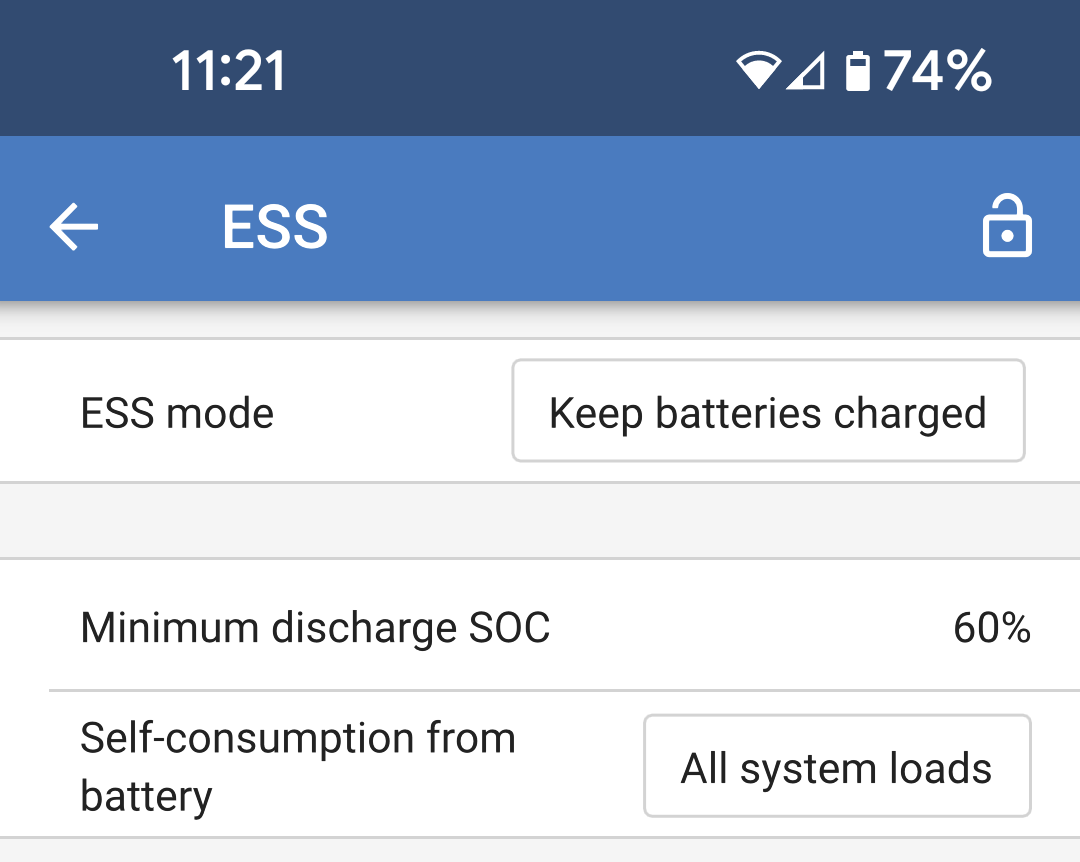
  • ESS mode: The factory default is "Keep batteries charged." Tap in the box to choose a different ESS mode. See the table below for details.

  • Minimum discharge SOC: This is the lowest SOC that the battery will be allowed to discharge down to. Once this limit is reached then power for the loads will be supplied from the AC input.

  • Self-consumption from battery: Allows energy from the battery to power all system loads or just the critical loads. This works in conjunction with one of the optimized ESS modes.

    Note

    This option will only be visible if "Energy meter support" is enabled.

MultiRS_ESS.png

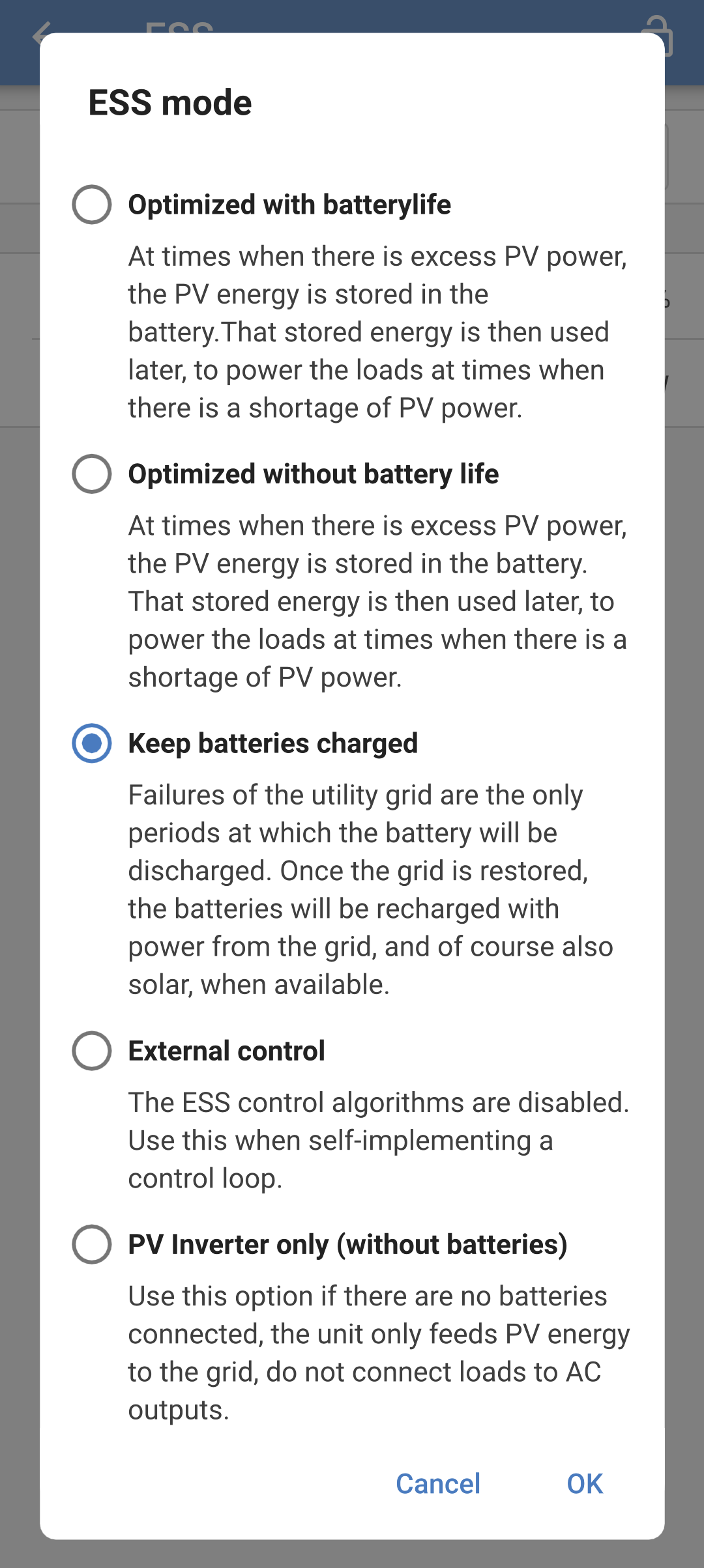
From the ESS mode popup box there are five options to choose from.

  • Optimized with batterylife: When there is enough solar power to satisfy the loads, then the excess solar power will be used to charge the battery. The power stored in the battery will then be used when the solar power is not enough or during the night.

    The batterylife algorithm will be active. This means that the minimum SOC level will gradually increase for each day that the battery is not fully charged. Once the battery gets fully charged then, the SOC level will reduce down to its originally set level.

    This is suitable for lead acid battery chemistries.

  • Optimized without batterylife: As above, when there is enough solar power to satisfy the loads, then the excess solar power will be used to charge the battery. The power stored in the battery will then be used when the solar power is not enough or during the night.

    Batterylife is not used, and so the minimum SOC level will remain at its preset level.

    This "Optimised" mode is best for lithium batteries.

  • Keep batteries charged: In this mode, the batteries will be kept fully charged as long as the AC input is available. Loads will be supplied from the AC input. If there is enough solar power, then this will be used to supply the loads, and excess solar will charge the battery if it is not fully charged.

    Use this mode in off grid installations to prevent feedback to a generator, which may be connected to the AC input.

    This mode should also be used where grid is available, but feed in is not permitted.

  • External control: There may be use cases where an external ESS control is required. There will be no automatic control of the ESS setpoints. All ESS setpoints will need to be written from an external appliance.

  • PV Inverter only (without batteries): In this mode it is possible to use the Multi RS without a battery. The unit operates as a normal PV inverter.

    Note

    This option will only appear if a grid code has been set.

    Do not connect any loads to the AC output.

MultiRS_ESS_mode.png

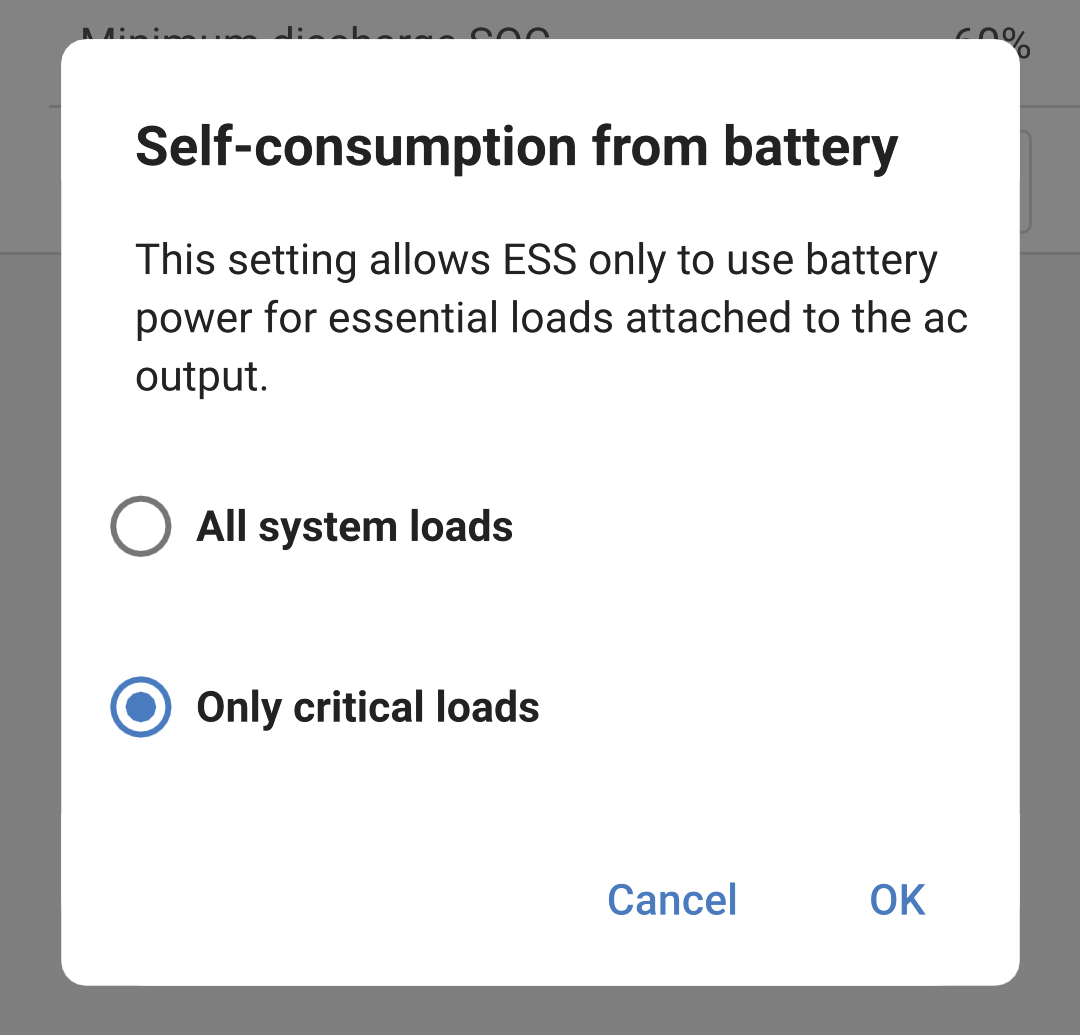
From the Self-consumption from battery popup there are two options:

Energy from the battery can be reserved to power only the critical loads on the AC output terminals.

  • All system loads: ESS will allow energy from the battery to supply power to loads on the AC Output as well as loads connected between the energy meter and the AC input terminals.

  • Only critical loads: Only critical loads connected at the AC output terminals will be powered from the battery. Non-critical loads connected between the energy meter and the AC input terminals will only be powered from grid energy and not the battery.

MultiRS_ESS_Self_consumption_from_battery.png