Where to buy
Need advice? Our highly trained dealers are happy to help with questions, small or large.
Find a dealer near you

Batteries in series or parallel: which is right for your system?
Learn about the differences between series and parallel wiring and how to implement them
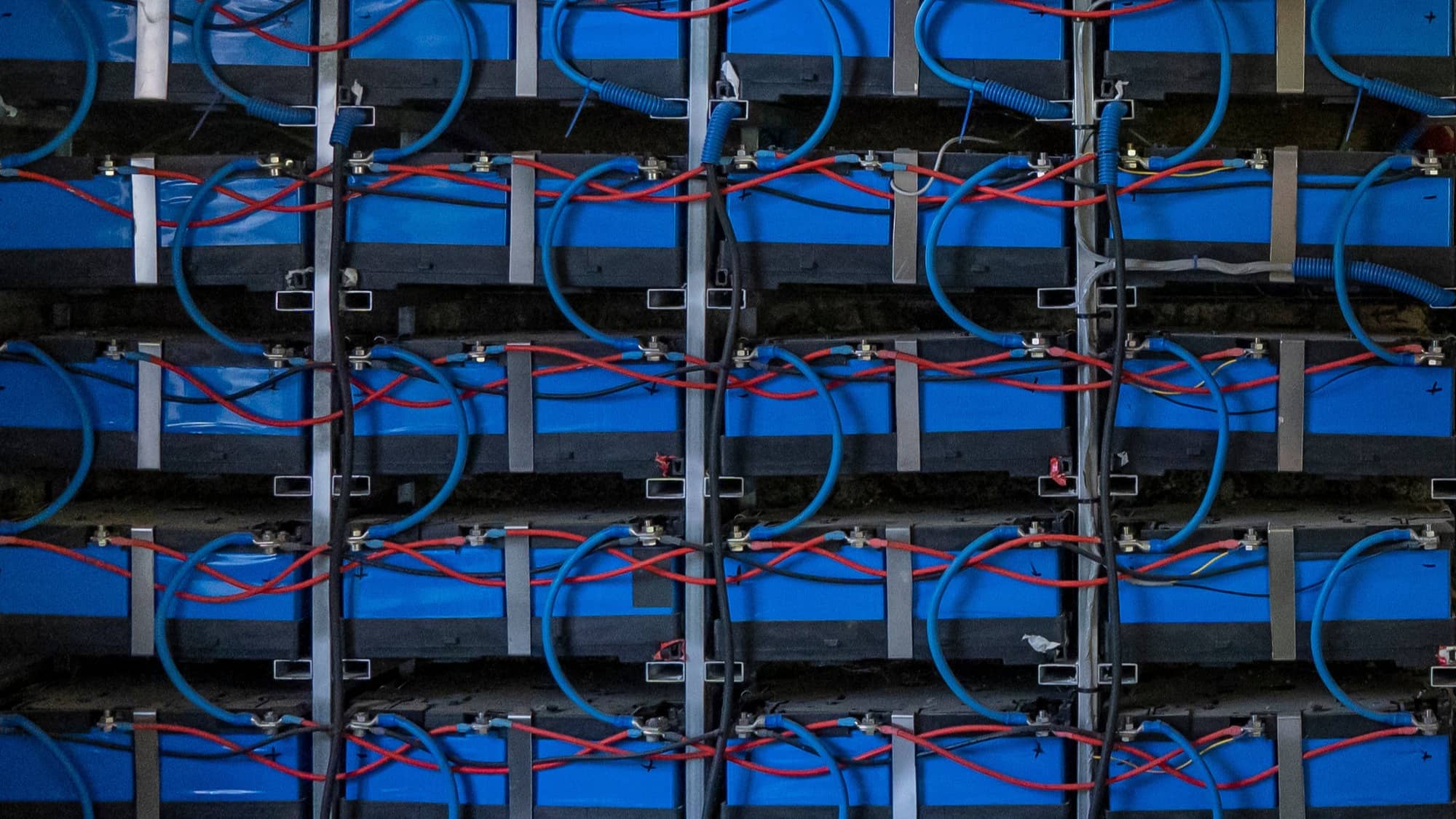
Wiring batteries in series or parallel are fundamentally different setups achieving different goals. Series wiring increases voltage, whilst parallel wiring increases capacity. In this article, we’ll look at why you might wire your battery bank in series or in parallel and the best practices that should be followed for each setup.
The difference between wiring batteries in series vs. parallel is that series wiring adds up the voltages of the individual batteries whilst keeping the amp-hour capacity of the bank the same, whilst parallel wiring adds the amp-hour capacity whilst keeping voltage the same.
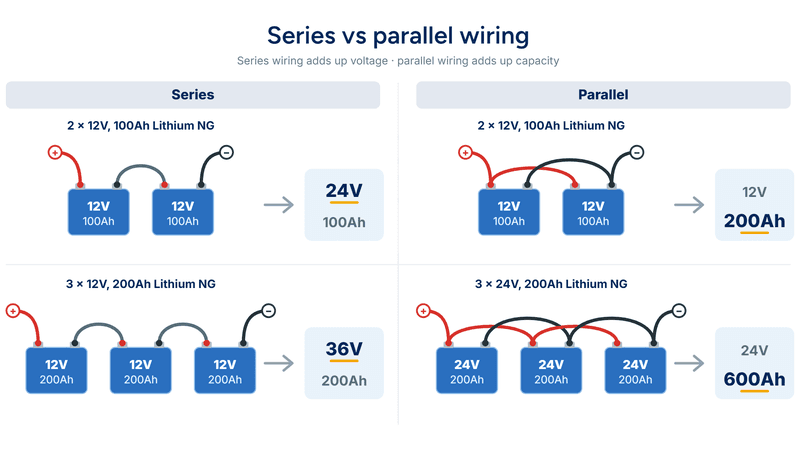
Practically, this means that when setting up a battery management system (BMS) or battery monitor, the capacity setting should be the sum of the capacities of the individual batteries in a parallel setup. In a series setup, the capacity of the bank is the same as the capacity of the individual batteries.
Note that the total electrical energy stored in the bank in watt-hours (Wh) doesn’t change whether the batteries are wired in series or parallel. As explained in our article on leisure battery sizing, the capacity in Wh is calculated by multiplying the capacity in amp-hours (Ah) by the voltage. Therefore, a battery bank consisting of two 12V, 100Ah batteries has a power storage capacity of:
(12 x 100) x 2 = 2,400Wh
Regardless of whether those batteries are wired in series or in parallel. What changes is how those 2,400Wh are distributed: at 12V and 200Ah or at 24V and 100Ah. How you wire your batteries does not change the total energy capacity.
Wiring your batteries in series will sum the voltage of the individual batteries. Two 12V batteries in series make a 24V battery bank, and four 12V batteries in series make a 48V battery bank. Let’s look at why you might increase the voltage of your battery bank whilst keeping the capacity in Ah the same.
Higher-voltage leisure batteries form the core of a higher-voltage electrical system. Some high-capacity systems with large amounts of stored power, big inverters, and big solar arrays perform better at higher voltages as it allows the system to run at lower currents.
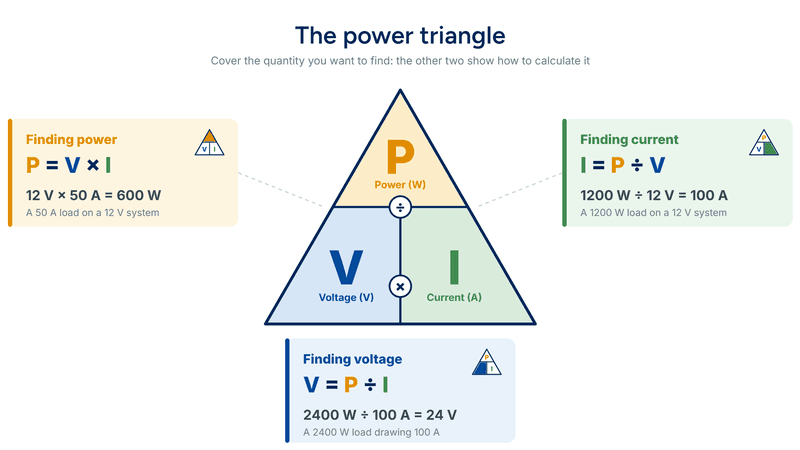
A 3,000W inverter/charger can pull 4,500W at peak power, equalling 375A at 12V. To protect this circuit, we’d need wiring, fuses, busbars, and switches all rated to 400A, giving us an adequate safety margin. Such wire is thick and hard to work with, and high-capacity wire, fuses, busbars, and switches are more expensive and harder to come by than lower-capacity components. By increasing the voltage to 24V, our 4,500W inverter/charger suddenly only pulls a maximum of 187.5A, allowing us to use wire, fuses, busbars, and switches rated to only 200A.
Electrical resistance increases with current and length of wire runs. In installations with inherently long wire runs, like boats and off-grid homes, this resistance can become a problem, causing wires to get unacceptably hot and impacting the function of components. Increasing system voltage decreases current, reducing resistance and making long wire runs more manageable.
Because MPPT solar charge controllers work at different battery voltages, a smaller, less expensive model can be used if battery voltage is increased. As discussed in our article on sizing solar systems, charge controllers are rated to a maximum solar input voltage and a maximum charge current. Because the charge controller can supply different voltages at this maximum charge current, it can charge at a higher wattage if voltage is increased. Looking at the manual for the 100/30 SmartSolar MPPT, we can see that it’s capable of supplying 440W at 12V and 880W at 24V. This means that a system with a 750W solar array would need to be supported either by a bigger, more expensive MPPT, or the 100/30 MPPT charging a 24V battery bank.
A 24V system is beneficial when high current is combined with long wire runs. For campervans, where wire runs are short, even systems based around 3,000W inverters and 900W solar arrays are manageable at 12V. In a van, sticking to 12V is simpler as the vehicle systems themselves, including the alternator, run at 12V. In addition, most fridges designed for campervans, as well as lights and fans, are 12V, with 24V variants being more expensive and harder to find. The benefits of a 24V system are offset by the need to buy and install a 12/24 DC-DC charger from the 12V alternator and a 24/12 converter for 12V appliances.

In trucks and boats, where cable runs are long and 24V alternators are common, a 24V system makes a lot more sense. The same is true in off-grid homes, where even 48V may be appropriate to handle the highest wattage system elements.
If using lithium batteries, it’s better to buy 24V batteries than wiring two 12V batteries in series. Batteries wired in series always receive the same charging current, but any slight difference in their internal chemistry can cause them to receive slightly different charging voltages, causing their state of charge to drift apart. To mitigate this, each one must be fully charged and balanced individually before connecting them. Once connected, a series-wired bank relies on a battery balancer or battery management system to ensure the individual batteries stay balanced. This is a more complex setup that must be wired and configured perfectly. Unbalanced batteries can cause:
In addition, it’s harder to upgrade the capacity of a series bank, as adding another battery in series changes the overall voltage of the bank. To upgrade, you need to add another identical series bank, wired in parallel with the original one. This series-parallel setup requires yet more complicated wiring and balancing. The other side of this coin is that if one battery in a series bank fails, the whole bank’s voltage changes and your whole electrical system is offline.
For these reasons, we would caution against wiring lithium batteries in series, as 24V and 48V lithium batteries are widely available.
If using lead-acid batteries, 24V or 48V batteries may be harder to find, and you may choose to buy 12V batteries. In that case, carefully-planned wiring and battery balancing is essential. Don’t hesitate to consult one of our authorised distributors and installers for advice and information.
Wiring your batteries in parallel increases the capacity in Ah whilst keeping voltage the same. As illustrated in our article on battery sizing, this is a well-supported wiring technique for building a battery bank of a desired capacity. If you decide you need 600Ah of usable battery capacity, you’ve more choice if you build this 600Ah bank from two 300Ah batteries or three 200Ah batteries rather than searching for a single 600Ah battery.
Because batteries wired in parallel receive the same voltage whilst dividing input current according to their capacity to receive it, parallel systems are considered ‘self-balancing’. Despite possible slight differences in internal chemistry, the system balances out as each battery receives a different portion of the overall current draw. No specific battery balancing is needed.
A parallel-wired battery bank is also drop-in upgradeable; adding capacity is as simple as adding another battery in parallel. The flipside here is that if one battery fails and needs removal, the rest of the bank continues at the same voltage with a reduced total capacity and the system can continue to run. Overall, a parallel-wired system is safer, more flexible, easier to set up, and offers more redundancy than a series-wired system.
Balancing is still a factor with parallel-wired batteries. A common mistake is to connect all the batteries together in parallel and then connect one side of this parallel bank straight to the rest of the electrical system:
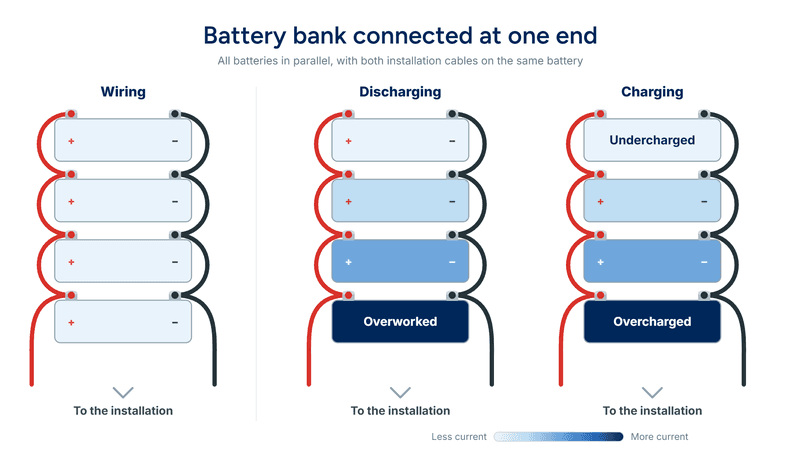
The problem is that the path from the charging and discharging appliances is much shorter for the bottom battery than the top battery. Electricity has to travel through more wires, connections, and other batteries to get to and from the top battery. Each of these elements provides resistance, meaning the top battery experiences much more resistance than the bottom battery. The result is that the bottom battery takes on more of the load, discharging and charging harder than the top battery, causing it to fail sooner and risking the whole bank becoming imbalanced. To mitigate this, when wiring batteries in parallel, the total paths current in and out of each battery must be equal. There are four ways to achieve this:

Wiring a parallel bank using one of these four methods will ensure that all the individual batteries charge and discharge the same way, keeping the whole system balanced. Read more about wiring battery banks in the relevant section in our Wiring Unlimited guidebook.
When designing a parallel-wired bank, using a smaller number of bigger batteries or a larger number of smaller batteries is largely a trade-off of simplicity against flexibility. A bank made of fewer batteries (or even a single large battery) is simpler to wire, with fewer fuses and connections and simpler monitoring. On the other hand, large batteries are harder to lift and can’t be as easily spread over multiple mounting locations. Additionally, we discussed the partial redundancy of multiple-battery parallel systems earlier: in a single-battery system, a battery failure shuts everything down.

One factor to note is that adding batteries adds wiring and connections, increasing the resistance of the battery bank. As stated in our Wiring Unlimited handbook, a 20cm length of 35mm² cable with lugs attached totals about 1.5mΩ (milliohms) of resistance. In a bank made up of more than four batteries, this resistance adds up quickly. Big solar arrays and powerful inverters would have their high current impeded by this resistance, impacting their performance. Therefore, for high-current systems, it’s worth keeping the number of individual batteries to the minimum that suits your use-case. Always keep the distance between individual batteries as short as possible.
This is a very commonly-asked question on our forums. Ideally, whether wiring batteries in series or parallel, all batteries should be of the same capacity, age, and model. Where this isn’t possible, the decision depends on the setup. In parallel-wired banks, batteries of different capacities and ages are acceptable. In series banks, capacities and part numbers must be the same, but an age difference of up to three years is acceptable.

Batteries in a parallel bank do not need to be the same brand. The above rules still apply, and if using lithium batteries, it’s important that the mandatory BMS be compatible with all individual batteries.
To summarise, wiring batteries in series or parallel are fundamentally different setups achieving different goals. Series wiring increases voltage, whilst parallel wiring increases capacity. Due to the wiring complexity, difficulty of balancing and dire consequences of a battery imbalance, and the fact that it’s neither redundant nor easily expandable, we would caution against wiring lithium batteries in series to build a higher-voltage bank. Instead, consider building your high-capacity electrical system around a 24V or 48V lithium battery bank if current and wire runs merit it. If you're using lead-acid batteries, 24V or 48V batteries may be harder to find at your desired capacity. In that case, careful wiring and balancing will be essential.
On the other hand, parallel wiring is a common and legitimate setup for building a high-capacity battery bank. Balancing is still a factor, but can be easily accounted for with thoughtful wiring. Consider how many batteries you’ll use for your paralleled bank, as this number affects the flexibility, simplicity, and internal resistance.

For much more information on battery bank wiring, take a look at the battery wiring section of our Wiring Unlimited handbook. For a detailed look at the differences between lead-acid and lithium batteries, take a look at our in-depth guide. Our guide to sizing your leisure batteries is also a good starting point. Remember, you're welcome to seek advice from one of our authorised distributors and installers.
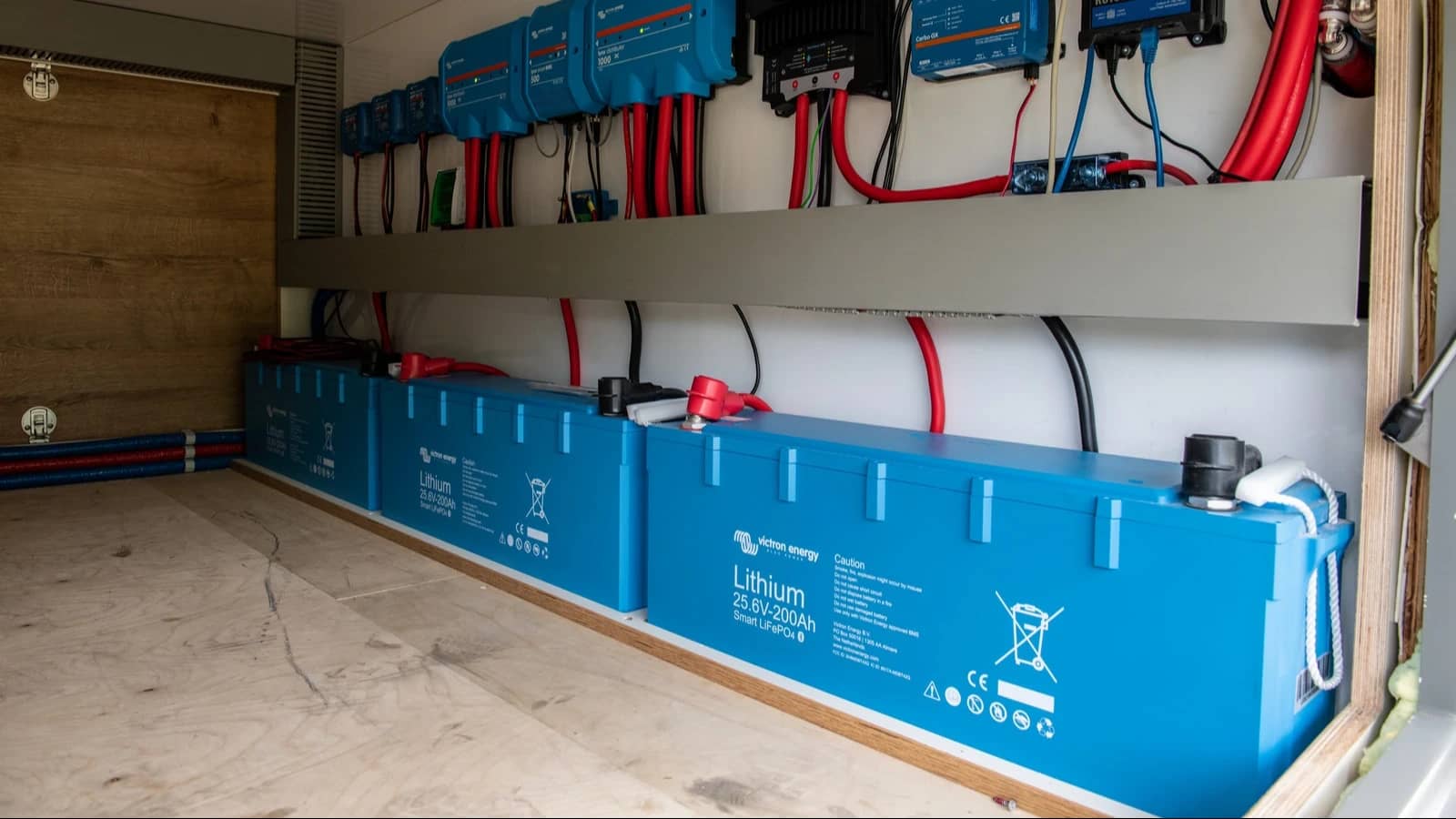
Douglas Edmond Steinman, Chris Wallace-Tarry • 12 September 2026
How to size an RV battery bank
How do you decide on a battery capacity for your RV? This article guides you through the calculations, step-by-step.
Chris Wallace-Tarry • 12 October 2026
How to charge RV batteries: 4 methods explained
An overview of the four main charging methods used to keep leisure batteries powered up.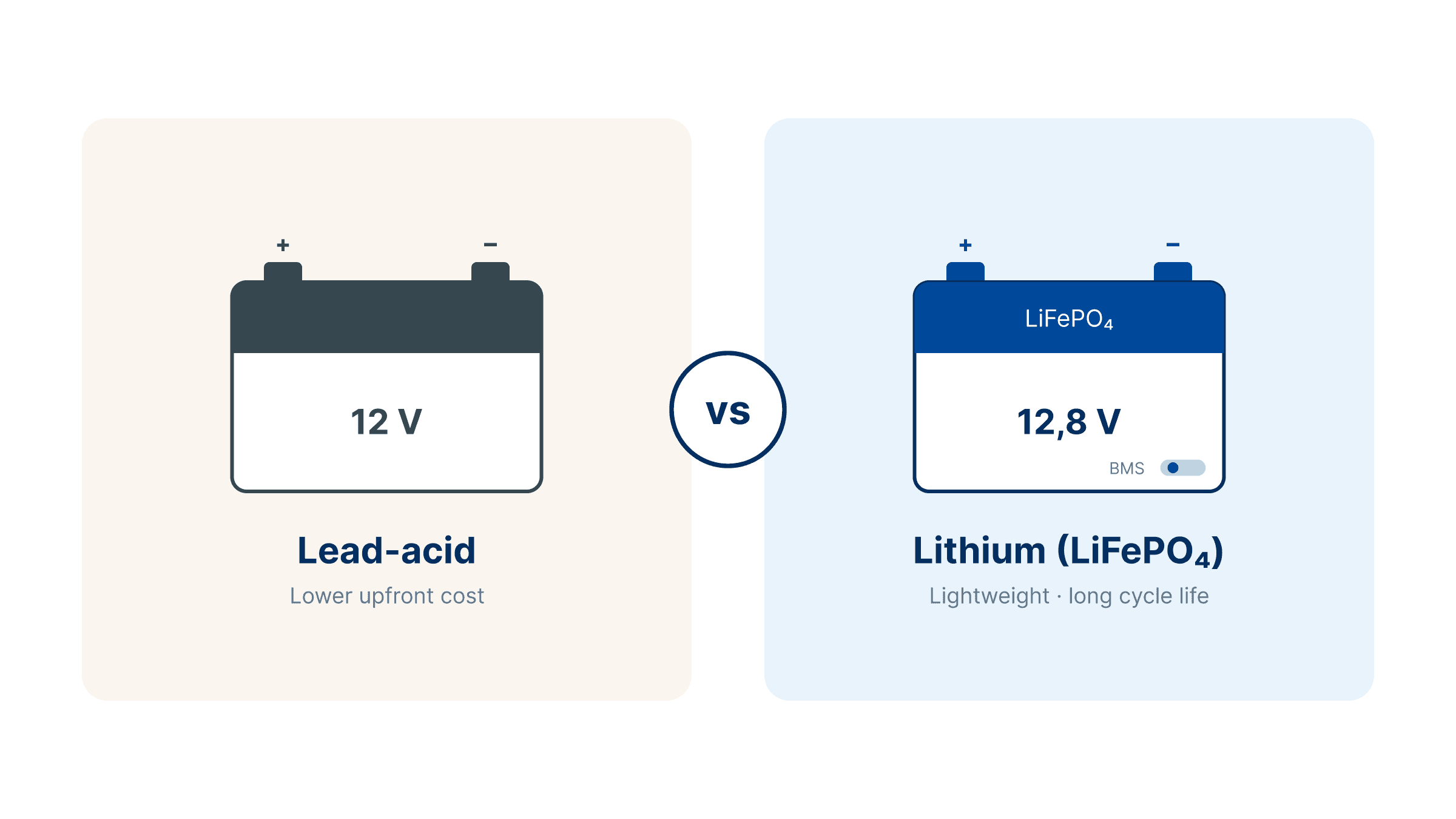
John Rushworth • 30 March 2015
Lithium-ion vs Lead-acid (AGM/Gel) Batteries
Lithium-ion vs Lead-acid (AGM/Gel): usable energy, depth of discharge & load performance compared.Need advice? Our highly trained dealers are happy to help with questions, small or large.
Find a dealer near you
Check our support resources or contact your original dealer for dedicated support, repairs or warranty requests.
Support
Read more about our industry-leading 5-year standard warranty and global repair service.
Warranty


©Victron Energy 2026