John Rushworth • 30 Mar 2015
Lithium-ion vs Lead-acid (AGM/Gel) Batteries
Learn more
Lead-acid battery lifespan
Understanding the causes of premature battery ageing and how to prevent them
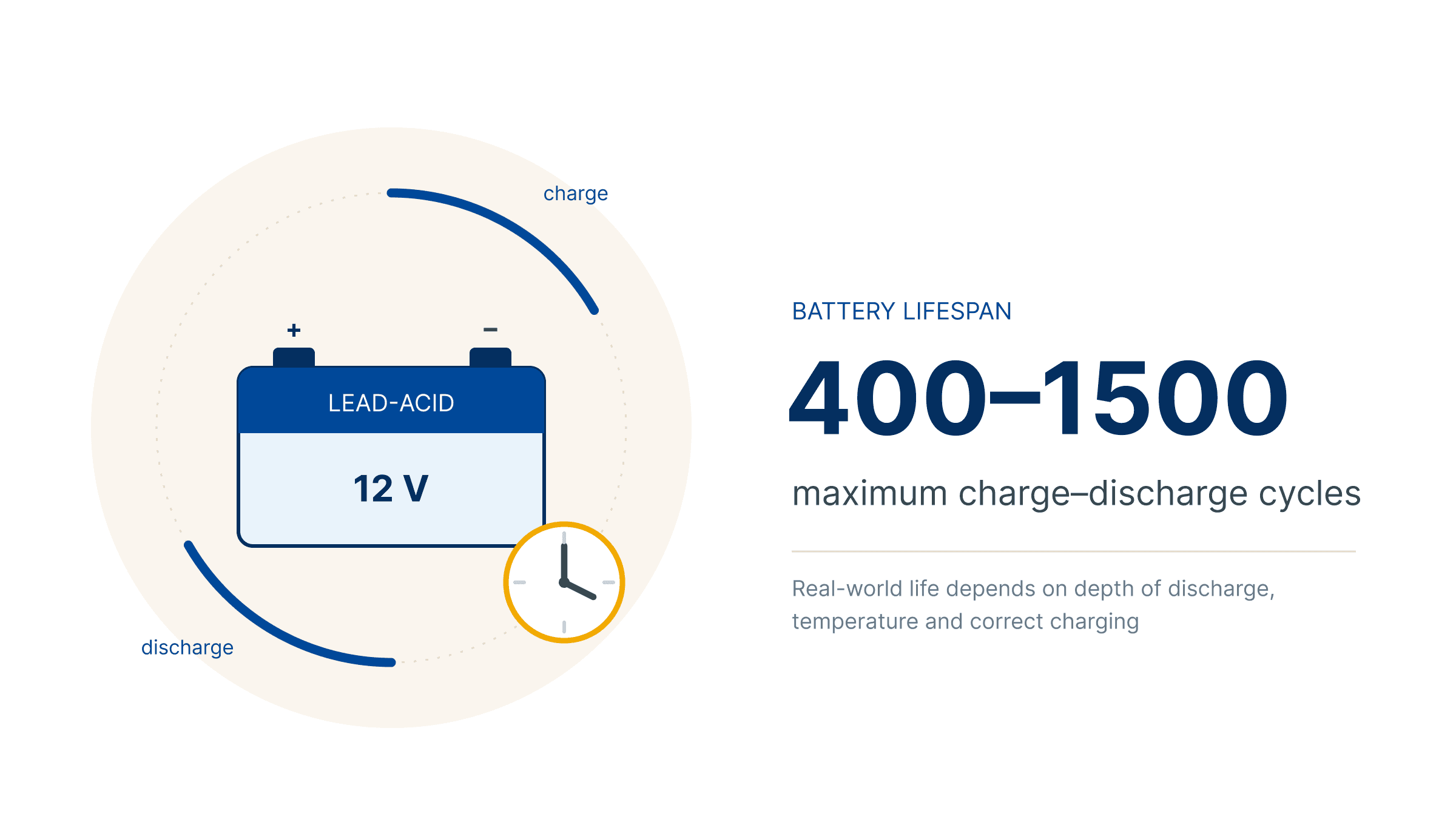
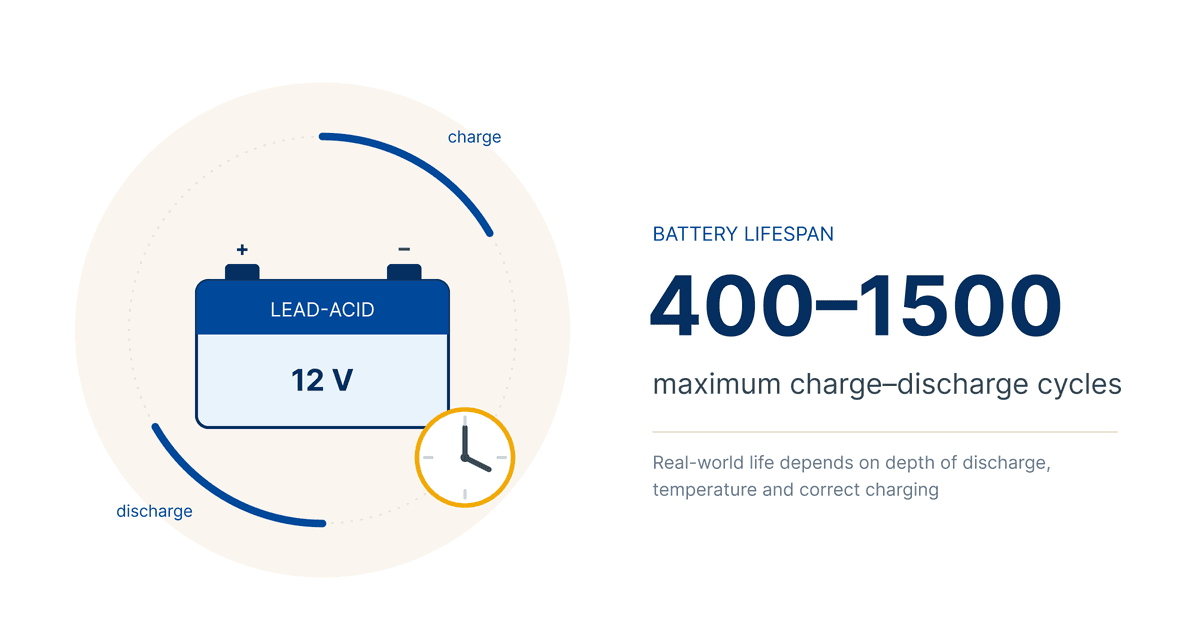
Depending on construction and use, the service life of a battery ranges from a few years to up to 10 years or more. The main causes of premature ageing in batteries are:
Effect on capacity of rapid discharging
The capacity of a battery is dependent on the rate of discharge. The faster the rate of discharge, the less Ah capacity will be available. In general the rated capacity is quoted for a discharge time of 20 hours (discharge current I = C / 20). For a 200 Ah battery this means that the rated capacity can be delivered at a discharge current of 200 Ah / 20 hours = 10 Ampères.
With a discharge current of 200 A the same battery becomes “flat” far sooner. For instance a 200 Ah gel battery then has an effective capacity of only 100 Ah and therefore becomes flat after 30 minutes.
The deeper a battery is discharged, the faster it will age due to shedding, and once a certain limit is exceeded (approx. 80% depth of discharge) the ageing process advances disproportionately fast. Additionally, if the battery is left discharged the plates will begin to sulphate. A battery ages even when kept charged and doing nothing, mainly due to oxidation of the positive plate grid.
Batteries are considered to have reached the end of their service life when the capacity they can hold has reduced to 80% of the rated capacity. Although most batteries will recover from a full discharge, it is nevertheless very detrimental to their service life. Batteries should never be fully discharged, and certainly not left in a discharged state.
It should also be noted here that the voltage of a battery that is in use is not a good measure for its level of discharge. Battery voltage is affected too much by other factors such as discharge current and temperature. Only once the battery is almost fully discharged (DoD 80% to 90%) will voltage drop rapidly. Recharging should have been started before this happened. Therefore a battery monitor is highly recommended to manage large, expensive battery banks effectively.
Batteries can be quickly charged and will absorb a high charge current until the gassing voltage is reached. While charging with such high current might work well a few times, this will actually shorten the service life of most batteries substantially (the exception: spiral-cell and some other AGM batteries). This is due to accelerated loss of cohesion of the active material, which results in shedding. Generally it is recommended to keep the charging current down to at most C / 5, in other words a fifth or 20 % of the rated capacity. For example, a 100Ah battery should be charged with a maximum 20A current.
When a battery is charged with currents exceeding C / 5, its temperature can rise steeply. Temperature compensation of the charging voltage then becomes an absolute necessity.
My own experience is that charging a 50 % discharged 12 V 100 Ah flooded battery at 33 A (C / 3) results in a temperature increase of 10 to 15°C. The maximum temperature is reached at the end of the bulk phase. Bigger batteries will become even hotter (because the amount of heat generated increases with volume and the dissipation of heat increases with the available surface) as well as batteries with a high internal resistance, or batteries which have been discharged more deeply.
Stratification of the electrolyte.
This problem is specific to batteries with liquid electrolyte. As a rule of thumb, one should not extend partial state-of-charge operation beyond approx. 30 cycles, and much less in case of very deep discharges. Returning a battery to full charge, regularly, helps prevent stratification.
Cell imbalance.
Cells of a battery are never identical. Some cells do have a slightly lower capacity than others. Some cells will also have lower charge efficiency than others. When a battery is cycled but not fully-charged, these weaker cells will tend to lag further and further behind the better cells. To fully-charge all cells, the battery has to be equalized (which means that the better cells will have to be overcharged. Imbalance will increase faster in case of very deep discharges or a very high charge rate. In order to prevent excessive cell imbalance, a battery should be fully recharged at least every 30 to 60 cycles.
Sulphation will occur when a battery is left in a fully-discharged condition. Sulphation will also take place - although at a slower rate - when a battery is left partially discharged. It is therefore recommended to never leave a battery more than 50 % discharged and to recharge to the full 100 % regularly, for example every 30 days. Batteries, especially low antimony flooded batteries, often are undercharged because the charge voltage is insufficient.
Note: Along with discharging too deeply, failing to fully-charge is the major cause of premature ageing in a battery.
Charging too much is, in sequence, the 3rd main cause of service life reduction of a battery.
Overcharging results in excessive gassing and therefore loss of water. In wet batteries water loss through excessive gassing can simply be replenished (yet the accelerated corrosion of the positive plates which takes place simultaneously is irreparable). However, sealed batteries which gas excessively cannot be replenished, and are therefore much more susceptible to overcharging. A frequent cause of excessive charging is the lack of temperature compensation or batteries being simultaneously charged using diode isolators.
The temperature of a battery can vary greatly for various reasons:
High ambient working temperatures result in accelerated aging because the rate of the chemical decomposition process in the battery increases with temperature. A battery manufacturer generally specifies service life at 20°C ambient temperature. The service life of a battery halves for every 10°C of rise in temperature.
Finally, temperature plays a big part in charging batteries. The gassing voltage and consequently the optimum absorption and float voltages are inversely proportional to temperature. This means that at a fixed charge voltage a cold battery will be insufficiently charged and a hot battery will be overcharged.
A battery at rest loses capacity as a consequence of self-discharge. The rate of self-discharge depends on the type of battery and temperature. Lead-acid batteries self-discharge at a rate of roughly 3–5% per month at room temperature, and as the charge drops, the lead sulphate that forms on the plates during discharge can gradually harden and crystallize (see sulphation above).
A lead-acid battery should ideally not sit unused for more than 3 to 6 months without being recharged, unless the average ambient temperature is low. Sealed batteries can be left without recharge for a period of 6 to 8 months.
When not in use for a long period of time, it is important to disconnect the battery from the electric system, keep the battery fully charged, store it in a cool dry place, and connect it to a maintenance charger (trickle charger) periodically to keep sulphation at bay.
Need advice? Our highly trained dealers are happy to help with questions, small or large.
Find a dealer near you
Check our support resources or contact your original dealer for dedicated support, repairs or warranty requests.
Support
Read more about our industry-leading 5-year standard warranty and global repair service.
Warranty


©Victron Energy 2026