Where to buy
Need advice? Our highly trained dealers are happy to help with questions, small or large.
Find a dealer near you
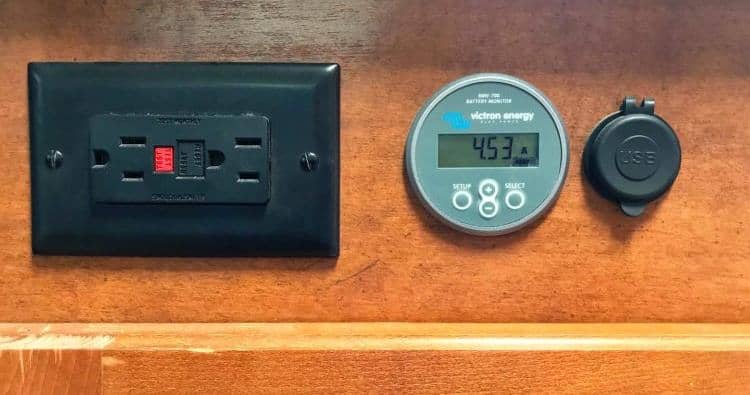
Lead-acid battery monitoring: How it works
Create an understanding of lead-acid battery monitoring
The electrolyte of a lead-acid battery consists of a mixture of water and sulphuric acid. When fully-charged, the active material in the negative plates is pure sponge lead; in the positive plates it is lead oxide. The concentration of sulphuric acid in the electrolyte (and consequently the SG) is then high.
During discharging the sulphuric acid from the electrolyte reacts with the active material in the positive and negative plates forming lead sulphate and water. This reduces the sulphuric acid concentration and consequently the SG of the electrolyte.
During discharging, the depth of discharge (DoD) of the lead-acid battery can be tracked quite well by using a hydrometer to monitor the SG of the electrolyte. The SG will decrease as shown in the following table:
The stratification problem
Because sulphuric acid is heavier than water, in batteries with liquid electrolyte it settles downwards, so that the acid concentration increases toward the bottom of the lead-acid battery (this does not apply to gel and AGM batteries). Above the plates - which is the electrolyte you will be testing - the acid concentration is at its least. This is particularly true for batteries that have been idle, and the condition is known as stratification. Remixing of the electrolyte will occur naturally during recharging when gassing voltage is reached.
Some useful information about electrolyte
Only once the gassing voltage (2.39 V per cell, or 14.34 V for a 12 V lead-acid battery at 20°C) is reached, will the electrolyte slowly become well mixed again by the percolation of gas bubbles.
The time needed depends on the construction of the lead-acid battery and on the amount of gassing. The amount of gassing in turn depends on the charge voltage, on the amount of antimony doping, and on the age of the lead-acid battery.
Batteries with relatively high antimony doping (2.5 % or more) in general do gas sufficiently during the absorption charge for the electrolyte to become homogeneous again.
Modern low antimony batteries (1.6 % or less antimony content) gas so little that a normal charge cycle is not sufficient. It then takes weeks of float charging (with very little gassing) before the electrolyte is well mixed again. As a result, flooded batteries - after having been fully charged - may nevertheless show a low hydrometer reading!
Vibration and motion in a boat or vehicle will often adequately mix electrolyte.
Temperature correction for hydrometer readings:
SG varies inversely with temperature. For every 14°C of temperature increase above 20°C, the hydrometer reading will decrease with 0.01. So a reading of 1.27 at 34°C is equivalent to a reading of 1.28 at 20°C.
Specific gravity variations per region:
The SG values mentioned in the table above are typical for a moderate climate. In hot climates SG is reduced as shown below in order to reduce the effect of temperature on service life of a lead-acid battery:
Battery voltage, too, can be used as a rough indication of the lead-acid battery’s state of charge, but it’s important to note that the battery should be left undisturbed for several hours (no charging or discharging) before a valid voltage measurement can be made.
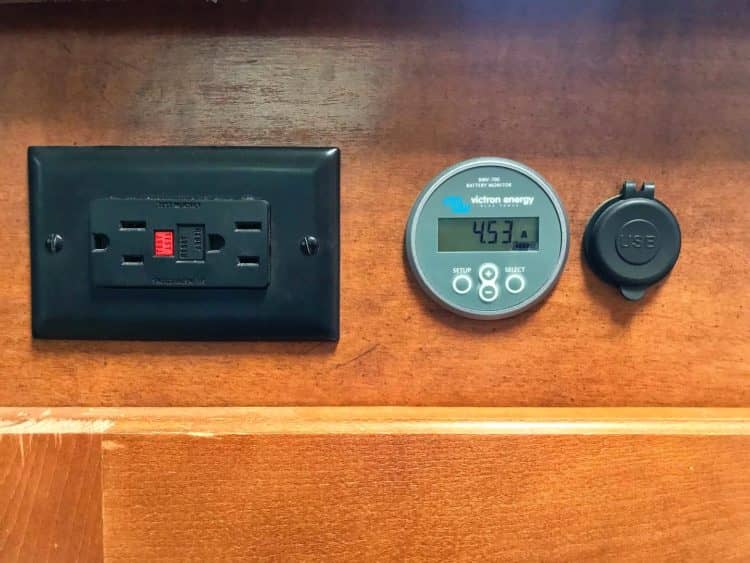
This is the most practical and accurate way to monitor a lead-acid battery’s state of charge. The product designed for this is the battery monitor. The following sections look in more detail at the use of the battery monitor.
The battery monitor’s main function is to record charged and discharged energy in order to indicate the state-of-charge percentage of a battery at any time.
When a lead-acid battery is charged or discharged, losses occur. The total quantity of electric energy that the lead-acid battery takes up during charging is approx. 25 % greater than the energy given out during discharging, which means an efficiency of 75 %. High charge and discharge rates will further reduce efficiency. The greatest loss occurs because the voltage is higher during charging than during discharging, and this occurs in particular during absorption. Batteries that do not gas much (low antimony batteries) and that have a low internal resistance are the most efficient.
When a battery is used in the partial state-of-charge mode, its energy efficiency will be quite high: approx. 89 %.
To calculate Ah charge or discharge of a battery, a battery monitor only makes use of current and time, so compensation for the overall efficiency is not needed.
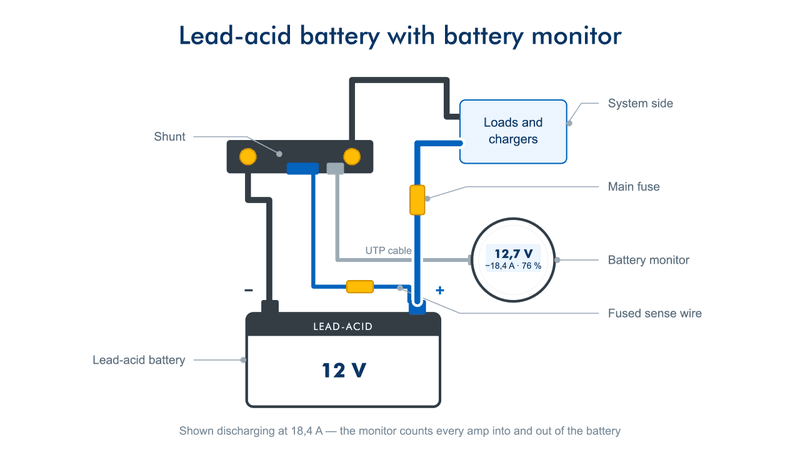
When a lead-acid battery is charged, more Ah have to be “pumped” in the battery than can be retrieved during the next discharge. This is called charge efficiency, or Ah or Coulomb efficiency (1 Ah = 3600 C).
The charge efficiency of a lead-acid battery is almost 100 %, as long as no gas generation takes place. Gassing means that part of the charging current is not transformed into chemical energy that is stored in the plates, but is used instead to decompose water into oxygen and hydrogen gas (this is also true for the “oxygen only” end of charge phase of a sealed battery). The “amp-hours” stored in the plates can be retrieved during the next discharge whereas the “amp-hours” used to decompose water are lost.
The extent of the losses, and therefore the charge efficiency depends on:
In practice charge efficiency will range between 80 % and 95 %. A battery monitor must take the charge efficiency into account otherwise its reading will tend to be too optimistic. If the charge efficiency has to be pre-set manually it is advisable to initially choose a low value, for example 85 %, and adjust later to suit practice and experience.
The capacity of a lead-acid battery is dependent on the rate of discharge. The faster the rate of discharge, the less Ah capacity will be available.
Increasing the discharge current from C / 20 to C / 1 (For example, in a 100Ah lead-acid battery, increasing the discharge current from 5 Amps to 100 Amps) can reduce effective capacity by as much as 50 % for a mono block gel battery.
A battery monitor should therefore compensate for the rate of discharge. In practice this is quite complicated because the discharge rate of a house battery will vary over time.
A 200Ah lead-acid battery is rated assuming a 20 hour discharge cycle - in this case a 10A draw.
Thus C20 = 200 Ah. The corresponding discharge current is:
However, under a discharge current of 200 A the battery will be flat in 30 minutes. So although we started with a 200 Ah lead-acid battery, it was flat after discharging just 100 Ah.
This does not mean that 100 Ah has “disappeared”. What happens is that the chemical process of diffusion is progressing too slowly, so that the voltage of the electrolyte becomes unacceptably low. A lead-acid battery discharged with a 200 A current and “flat” in 30 minutes will therefore also be (nearly) fully-charged again when it has been recharged with 100 Ah. The same lead-acid battery which is discharged at a rate of 10 A and flat in 20 hours will be nearly fully-charged after recharging 200 Ah.
In fact a lead-acid battery which has been discharged at a very high rate will recover over time and the remaining capacity can be retrieved after the battery has been left at rest for several hours or a day.
Apart from the voltmeter and alarm functions, very useful features of a battery monitor are ‘event counting’ and data logging.
Event counting means that specific events; especially events that are potentially damaging or those needed for lead-acid battery maintenance are stored in a memory of the battery monitor.
Such events could be:
Data logging allows users to view an archived history of battery use for analysis. This can help identify trends over time, such as a gradual decline in capacity or a pattern of shallow discharges that may be shortening battery life. It's also useful for troubleshooting: if a battery underperforms or fails prematurely, the logged history can help pinpoint whether the cause was abuse, a charging fault, or normal end-of-life degradation.
Of the three methods described above, specific gravity and battery voltage can both give a useful rough indication of state of charge, but each has limitations: SG measurements are affected by stratification and temperature, and voltage readings are only meaningful after the battery has rested for several hours. The amp-hour meter, or battery monitor, avoids both of these pitfalls by tracking energy in and out of the battery directly, which is why it remains the most practical and accurate way to monitor state of charge on an ongoing basis. For anyone who depends on their battery bank day to day - rather than checking it occasionally with a hydrometer or multimeter - a properly configured battery monitor, accounting for charge efficiency and discharge rate, is the better long-term investment.
Justin Tyers • 02 September 2026
How do lead-acid batteries work?
How lead-acid batteries work: the chemistry behind charging, discharging, and energy storage.
Justin Tyers • 10 August 2026
The most common types of lead-acid batteries
Lead-acid batteries differ in alloy, electrolyte type, and build. Learn which one fits your needs.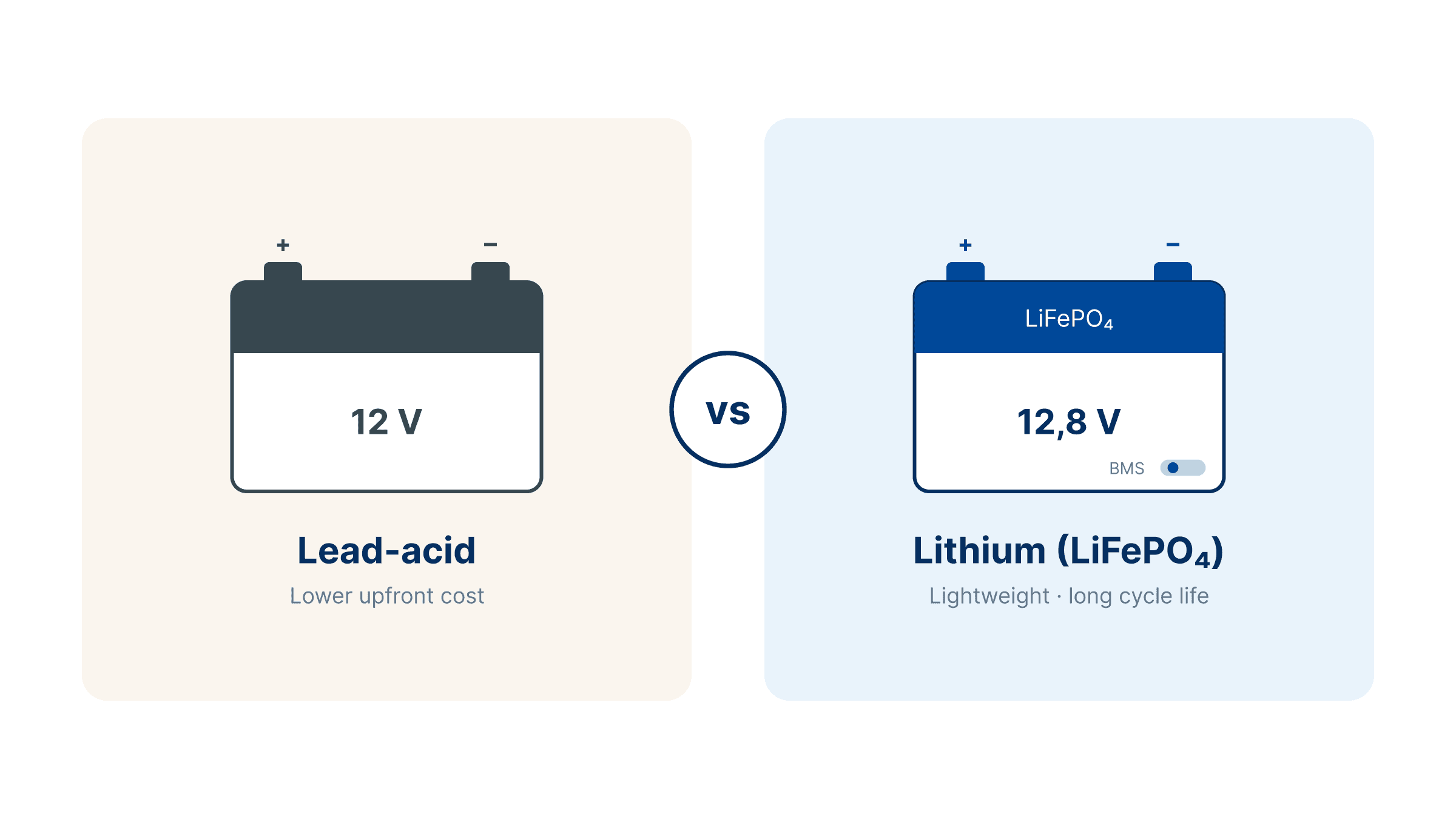
John Rushworth • 30 March 2015
Lithium-ion vs Lead-acid (AGM/Gel) Batteries
Lithium-ion vs Lead-acid (AGM/Gel): usable energy, depth of discharge & load performance compared.Need advice? Our highly trained dealers are happy to help with questions, small or large.
Find a dealer near you
Check our support resources or contact your original dealer for dedicated support, repairs or warranty requests.
Support
Read more about our industry-leading 5-year standard warranty and global repair service.
Warranty


©Victron Energy 2026