Where to buy
Need advice? Our highly trained dealers are happy to help with questions, small or large.
Find a dealer near you
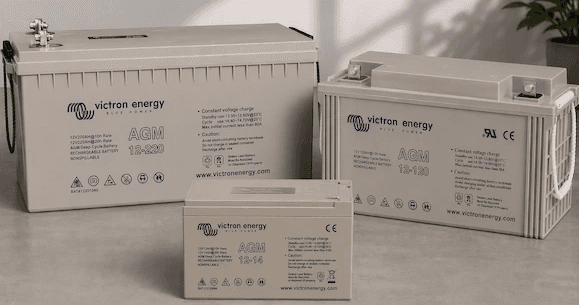
The most common types of lead-acid batteries
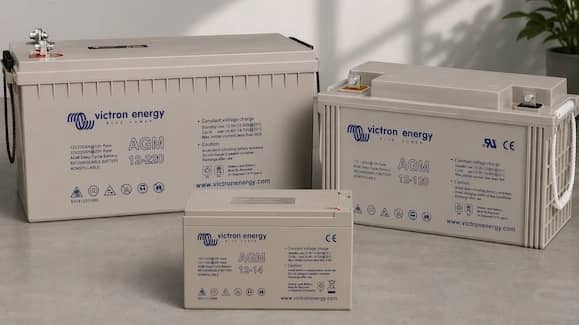
Not all lead-acid batteries are built the same way. They can differ in the alloy used to harden their plates, how their electrolyte is held (liquid, gel, or absorbed glass mat), and their mechanical construction — all of which affect performance, lifespan, and maintenance needs. Below, we break down these differences to help you understand which type suits your needs.
Lead is alloyed with antimony (and other elements) or with calcium to make it harder, more durable and easier to process. For the user it is important to know that compared to lead-calcium batteries, batteries alloyed with antimony have a higher rate of internal self-discharge and require a higher charge-voltage, but also will sustain a greater number of charge/discharge cycles.
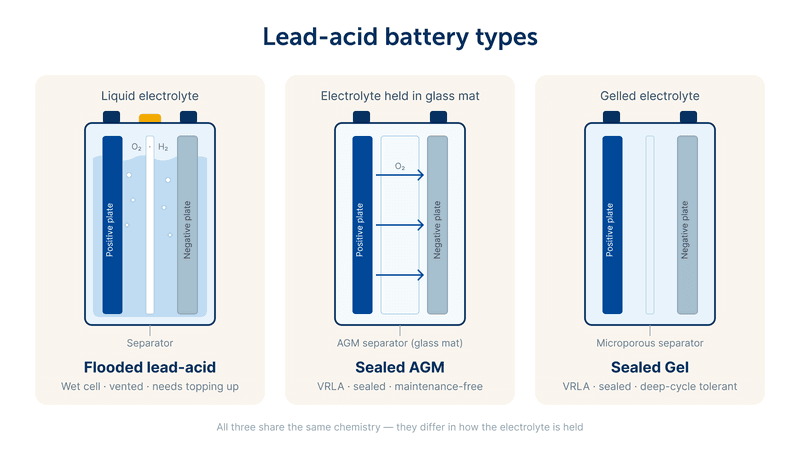
The electrolyte in a battery is either liquid - known as ‘wet’ or ‘flooded’ batteries; or it is ‘starved’ - formed into a gel, or absorbed in microporous material known as the absorbent glass mat (AGM battery).
When nearly fully charged, wet or flooded batteries will start “gassing”, which is the result of water being decomposed into oxygen- and hydrogen gas.
In batteries with starved electrolyte, oxygen gas formed at the positive plates migrates to the negative plates where, after a complicated chemical reaction, it is “recombined” with hydrogen into water. No gas will escape from the battery. Hydrogen gas is formed only if the charge voltage is too high. In case of excessive charge, voltage oxygen and hydrogen gas will escape through a safety valve. That is why these batteries are also called VRLA (Valve Regulated Lead Acid) batteries.
These batteries may be distinguished on the basis of their mechanical construction and purpose:
This is the battery used in cars. Not suitable for frequent deep discharging, it has thin plates with a large surface area designed purely for the short-term high discharge currents which are ideal for engine starting.
Nevertheless flat-plate heavy-duty truck starter batteries are often employed as house batteries in smaller boats.
This battery has thicker plates and better separators between the plates to help prevent buckling of the plates and shedding of the active material under cyclic use. It can be used for light duty cycling and is often referred to as a ‘leisure’ duty battery.
The thick plate deep-cycle battery must be charged, at least from time to time, at a relatively high voltage. How high depends on chemical and constructive details and on the charging time available.
High charging voltage is needed to reconvert all sulphate into active material, and to help prevent stratification of the electrolyte. Once the gassing voltage is reached, charging is continued with plenty of current (and therefore a high voltage). The resulting gas generation ‘stirs’ the electrolyte and ensures that it becomes well mixed again.
Here the electrolyte is immobilised as gel. Silica is added to the sulfuric acid electrolyte, causing it to set into a thick, gel-like paste rather than remaining a free-flowing liquid. This makes the battery fully sealed and spill-proof, so it can be mounted on its side or at odd angles without leaking. Gel batteries also tend to tolerate deep discharges well and have a long service life, but they charge more slowly and are more sensitive to overcharging than AGM batteries, so they typically need a charger with a gel-specific charge profile.
AGM stands for Absorbed Glass Mat. In these batteries the electrolyte is absorbed (“sucked up”) into a glass-fibre mat between the plates by capillary action. In an AGM battery the charge carriers, hydrogen ions (H2) and sulphate ions (SO4), move more easily between the plates than in a gel battery. This makes an AGM battery more suitable for short-time delivery of very high currents than a gel battery.
VRLA batteries offer greater ease of use than wet or flooded batteries as they’re maintenance free; don’t gas (provided that the battery is not charged with excessive voltage), and can therefore be installed in out of reach spaces with difficult access.
On the other hand sealed batteries are very sensitive to overcharging (the exception is the spiral-cell battery). Overcharging results in gassing (through the safety valve) which means water loss that can never be replenished, resulting in capacity loss and premature aging.
Need advice? Our highly trained dealers are happy to help with questions, small or large.
Find a dealer near you
Check our support resources or contact your original dealer for dedicated support, repairs or warranty requests.
Support
Read more about our industry-leading 5-year standard warranty and global repair service.
Warranty


©Victron Energy 2026