Where to buy
Need advice? Our highly trained dealers are happy to help with questions, small or large.
Find a dealer near you
How do lead-acid batteries work?
The chemistry behind charging, discharging, and diffusion
The battery is a secretive product. From the outside there is nothing to tell us about its quality, possible ageing or state-of-charge. A battery, when it fails, has to be replaced. That’s it.
Also, batteries are very vulnerable. Overcharging, undercharging, discharging too deeply, charging too fast, excessive temperature…. All these issues can occur and the consequences can be disastrous.
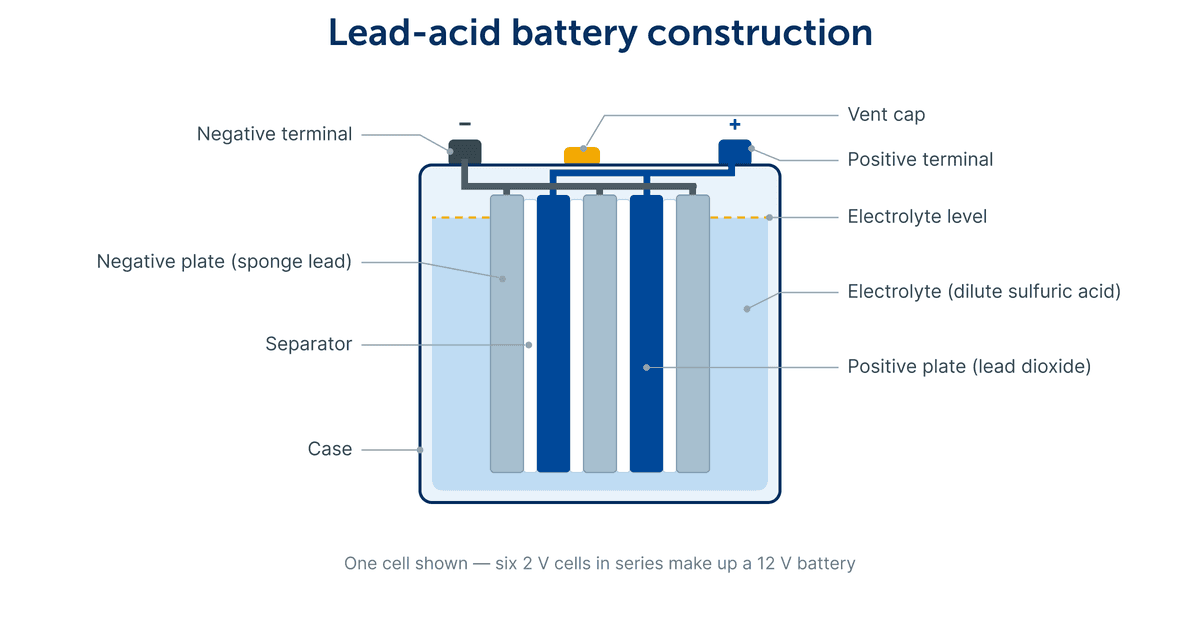
A lead-acid battery stores and releases energy through a chemical reaction between two lead-based plates submerged in a mixture of sulphuric acid and water. When discharging, the chemical reaction between the plates and the acid produces electricity. When a battery is recharged, that process runs in reverse - pushing electrical energy back in which restores the chemicals to their original state so the whole cycle can happen again.
What happens in a cell as it discharges?
As a cell discharges lead sulphate forms on both the positive and negative plates through absorption of acid from the electrolyte. This difference in chemical potential between the two plates creates a voltage - essentially an "electron pressure" - that drives electrons through the external circuit (your device), producing usable electrical current. The quantity of electrolyte in the cells remains unchanged. However, the acid content in the electrolyte reduces - a change which can be measured in the specific gravity of the electrolyte.
An external voltage source - a battery charger or alternator - forces current through the battery in the opposite direction, reversing the discharge reactions. On both plates acid is released, while the positive plate converts into lead oxide and the negative plate into porous, sponge-like lead. Once charged, the battery can no longer take up energy and any further energy will decompose water into hydrogen gas and oxygen gas. A battery charger tapers the charge current toward the end of the charge cycle as overcharging will deplete the electrolyte and pose a safety risk due to flammable hydrogen gas buildup.Short description with image
When a battery is being discharged, ions have to move through the electrolyte and through the active material of the plates to come into contact with the lead and lead oxide that has not yet been chemically converted into lead sulphate. This moving of ions through the electrolyte is called diffusion. When the battery is being charged the reverse process takes place. The diffusion process is relatively slow, and as you can imagine, the chemical reaction will first take place at the surface of the plates, and later (and also more slowly) deep inside the active material of the plates.
The battery acts as a buffer between the power sources (DC generator, battery charger, solar panel, wind generator, alternator, electricity grid) and the power consumers (DC lighting and pumps etc; and - with an inverter - AC powered appliances).
An off grid battery-based installation usually experiences cyclic daily use - recharging during the day, and discharging during the night or quiet periods. In mobile off grid installations - mobile homes and boats - there may be long idle periods of winterization, or long periods where the battery is connected to the electricity grid.
The job of the battery is to ensure power is always available.
The number of charge/discharge cycles per year, the ambient temperature and many other factors influence a battery’s service life.
John Rushworth • 30 March 2015
Lithium-ion vs Lead-acid (AGM/Gel) Batteries
Lithium-ion vs Lead-acid (AGM/Gel): usable energy, depth of discharge & load performance compared.
Justin Tyers • 10 August 2026
The most common types of lead-acid batteries
Lead-acid batteries differ in alloy, electrolyte type, and build. Learn which one fits your needs.Need advice? Our highly trained dealers are happy to help with questions, small or large.
Find a dealer near you
Check our support resources or contact your original dealer for dedicated support, repairs or warranty requests.
Support
Read more about our industry-leading 5-year standard warranty and global repair service.
Warranty


©Victron Energy 2026