John Rushworth • 9 Jan 2019
Lead acid battery charging in cold weather
Learn more

How to store RV batteries for the winter

If you put your RV in storage at the end of the year, it’s important to understand how to store your RV batteries. What you do with your batteries largely depends on the chemistry, with lead-acid batteries needing different treatment than lithium. This article will go over leisure battery winter storage, explaining first what happens to your batteries when they’re stored in the cold and not used. We’ll then talk about preparing your batteries for winter storage, how to protect them once they’re in storage, and how to recommission them again in spring.
What drains RV batteries in storage? There are two main mechanisms by which RV batteries in winter storage gradually lose charge, which can drain the battery to damaging levels given enough time.
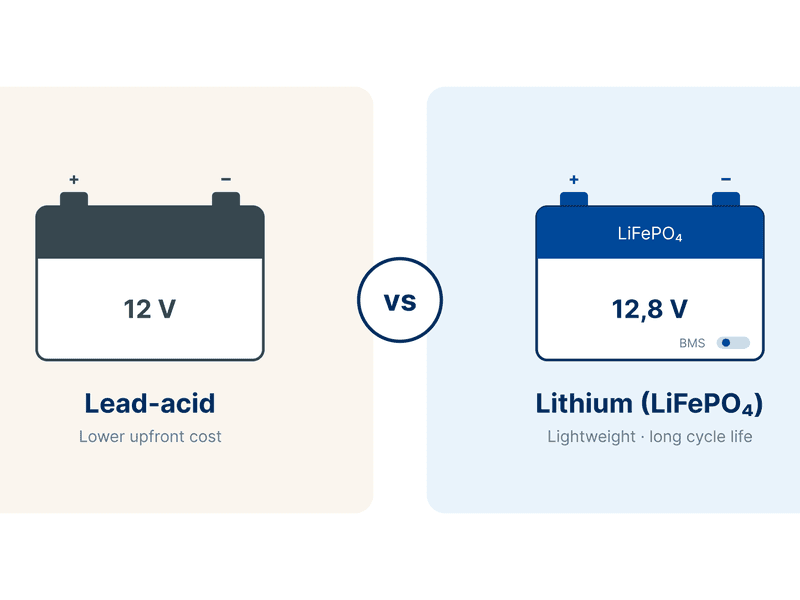
All chemical batteries experience self-discharge; a slow loss of charge due to low-level chemical reactions happening inside the cells at rest. Flooded lead-acid batteries experience relatively high self-discharge, whilst Victron AGM and gel batteries experience less than 2% a month at 20°C (this roughly doubles for every 10°C rise, and is lower at lower temperatures). Lithium batteries experience even slower self-discharge. Read more about the differences between the different RV battery types here.
Even when an electrical system isn’t being used, there can exist many small loads that drain the battery over time:
Do not rely solely on your BMS's low-voltage disconnect
Quality BMSs incorporate low-voltage disconnect switches, which disconnect the loads controlled by the BMS when the battery reaches a dangerously low state of charge. Low-voltage disconnect does not, however, disconnect the battery’s internal electrics or the BMS itself, meaning these circuits can still contribute parasitic drain when the battery is ostensibly ‘safe’ thanks to the low-voltage disconnect.
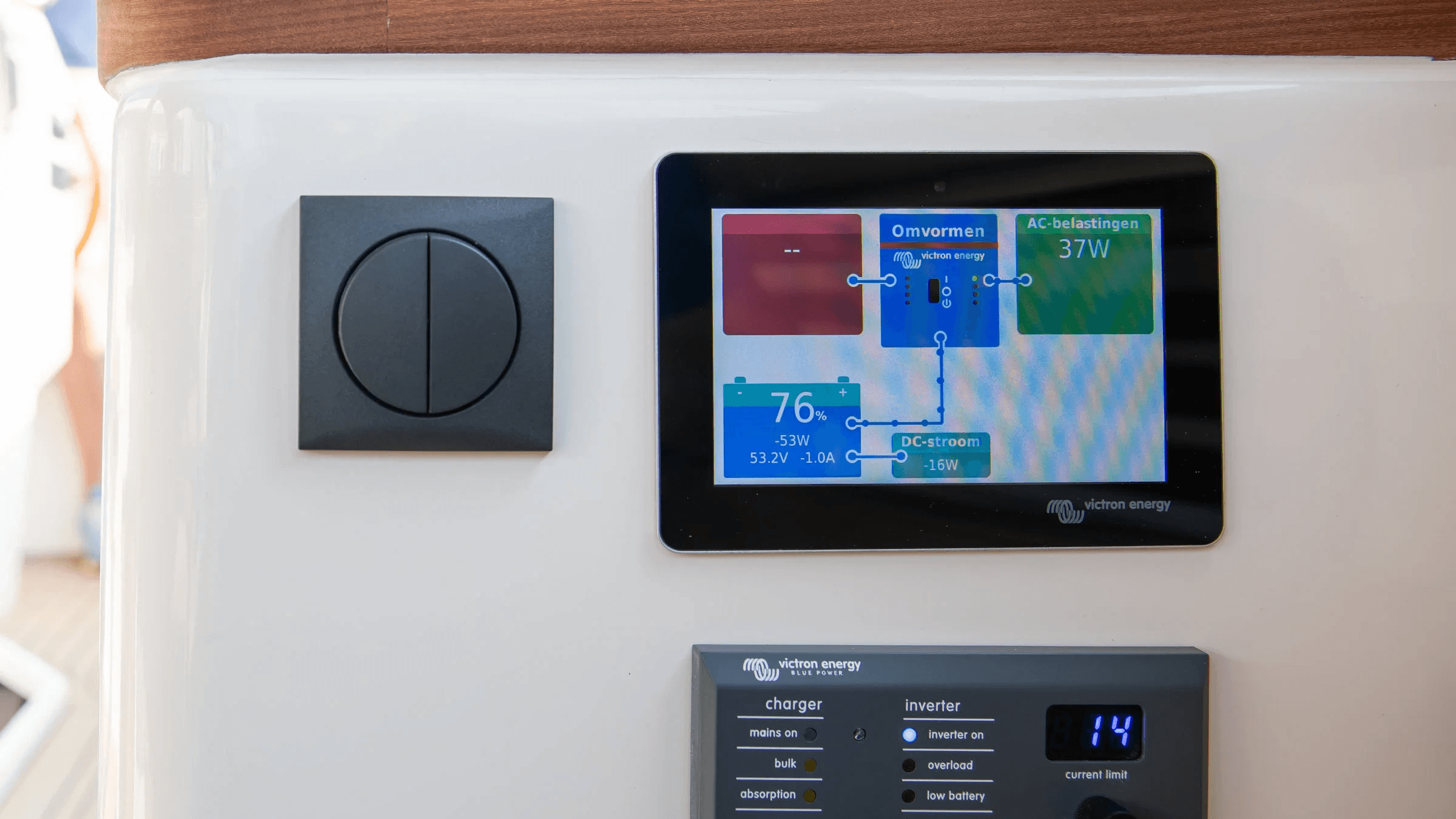
Touchscreens and LED indicators on control panels can contribute to parasitic load if not disconnected.
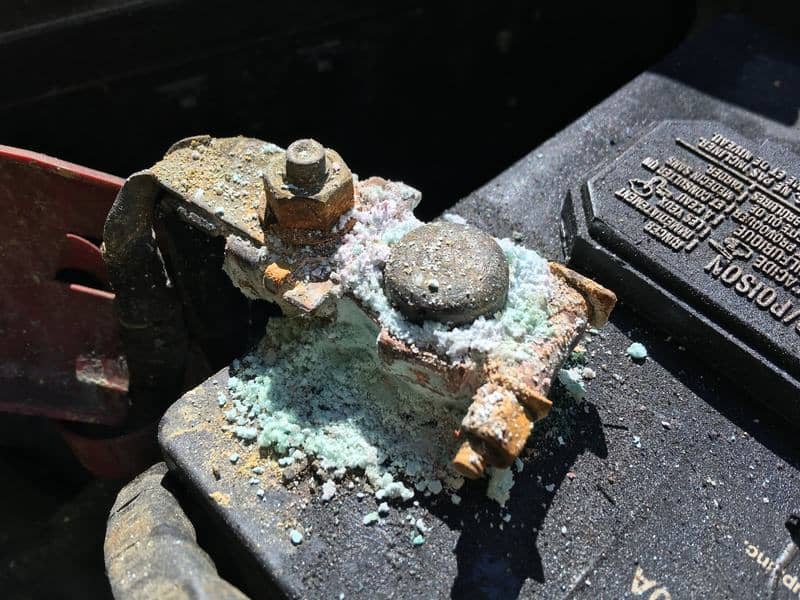
If, through self-discharge and parasitic drain, an RV battery in winter storage is allowed to drain too deeply, its chemistry becomes permanently damaged. Lead-acid batteries experience sulphation, where sulphate crystals form on the electrodes and harden over time. Hard sulphate is difficult or impossible to convert back to useful sulphuric acid, resulting in a permanent loss of battery capacity. Lead-acid batteries begin to sulphate whenever they sit below full charge, and the damage grows the lower and longer they stay there. A completely discharged lead-acid battery can also freeze in sub-zero temperatures, which cracks the case and permanently decommissions the battery. Lithium cells are damaged by over-discharge, also permanently reducing their usable capacity and shortening the battery’s lifespan.
This is why understanding how to store RV batteries for winter is so important. We need to ensure that the battery doesn’t over-discharge through self-discharge and parasitic drain. We’ll cover the possible solutions to this problem in the following sections.
Safely storing your RV batteries through winter starts with giving them a full charge. Lead-acid batteries should be charged to 100% with a full absorption phase. Lithium batteries should generally be charged to near-full; some sources advise that they be charged to 50%, but this isn’t a catch-all for all lithium batteries. Check your battery’s manual for guidance on the storage charge level.
Once your battery is charged to 100% (lead-acid) or the level specified in the manual (lithium), inspect and clean the terminals and cable lugs, as well as any case material that could bridge the two terminals. A build-up of moisture or corrosion across the top of the battery can eventually create a current leakage path between the two terminals, which can gradually drain the battery. Corroded or dirty terminals impede a battery maintainer or solar charge controller (discussed in the next section) charging it properly. In general, terminals should be inspected and cleaned regularly, and preparing for winter storage is a good time to do it. Flooded lead-acid batteries need a full top-up of electrolyte after the full charge.
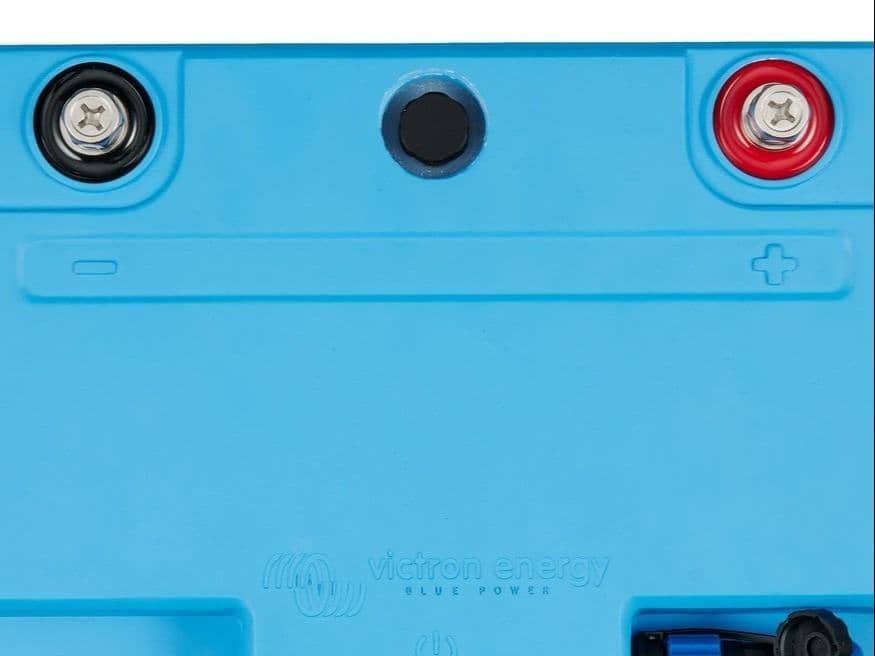
Clean battery terminals are essential for safe winter battery storage
Finally, switch off every load you can. All 12V loads should be switched off, as should inverters and auxiliary equipment. Unplug or switch off your fridge if you can, and unplug touchscreens and Wi-Fi routers if possible. This is where isolator switches are useful, as a single point can be used to definitively shut off power to multiple loads.
With your battery charged and the terminals cleaned, you need to decide whether you’ll disconnect the battery or keep it connected and maintain its charge with a battery maintainer.
Keeping the battery connected and using a battery maintainer or battery tender is the best solution for batteries whose self-discharge rate means they may not last a full winter unattended. Estimate how much charge the battery will lose through self-discharge over the storage period, and compare it with how far the manual says it can drop before recharging. Sulphation begins as soon as a lead-acid battery sits below full charge, and it gets worse the lower and longer the battery stays there, so a battery that drifts down over winter loses some capacity for good even if it never goes flat. Your battery’s manual will tell you how far its state of charge can drop before it needs recharging.
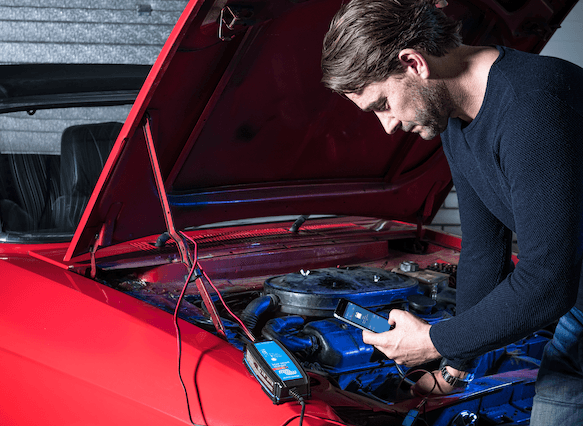
Battery maintainers/battery tenders are low-current battery chargers specifically designed for long-term storage.
Lithium batteries and Victron AGM and gel batteries have such low self-discharge that they can generally be left isolated and disconnected through winter if fully charged first. Other lead-acid batteries, and especially flooded lead-acid batteries, have higher self-discharge figures and may need a top-up or two during the storage period. In these cases, a battery maintainer eliminates the need for these regular checks and top-ups.
A battery maintainer holds the battery at a reduced storage voltage and tops it up periodically, keeping it at a healthy state of charge and requiring no intervention during the storage period. If some loads must stay powered, such as an alarm or tracker, a maintainer can cover them, provided it can supply more than they draw. Bear in mind that this solution is only viable if there’s a source of reliable mains power in your storage location. If there’s no source of reliable mains power, but you’re storing your RV outside, a solar charge controller can maintain the battery if the panels stay clear and get reasonable sun, and it’s set to the right chemistry profile. It must also be connected on the battery side of any isolator switch.
If there’s no source of mains power and solar power isn’t an option (because you’re storing your RV inside or under shade, you’re storing it through an Arctic winter, solar panels may be covered in snow, or you don’t have solar panels), isolation is the best option for lead-acid batteries with low self-discharge. This is the simplest option for lithium batteries stored below their minimum charging temperature (+5°C for Victron Lithium Smart batteries; check your manual). Flooded lead-acid batteries and gel or AGM batteries with high self-discharge rates may need to be removed and kept closer to home.
Isolating your RV batteries for storage means completely disconnecting them from all loads. Using an isolator switch installed close to the battery terminal, before any distribution points or loads, is the simplest way. If you haven’t installed an isolator switch, remove the main battery fuse.
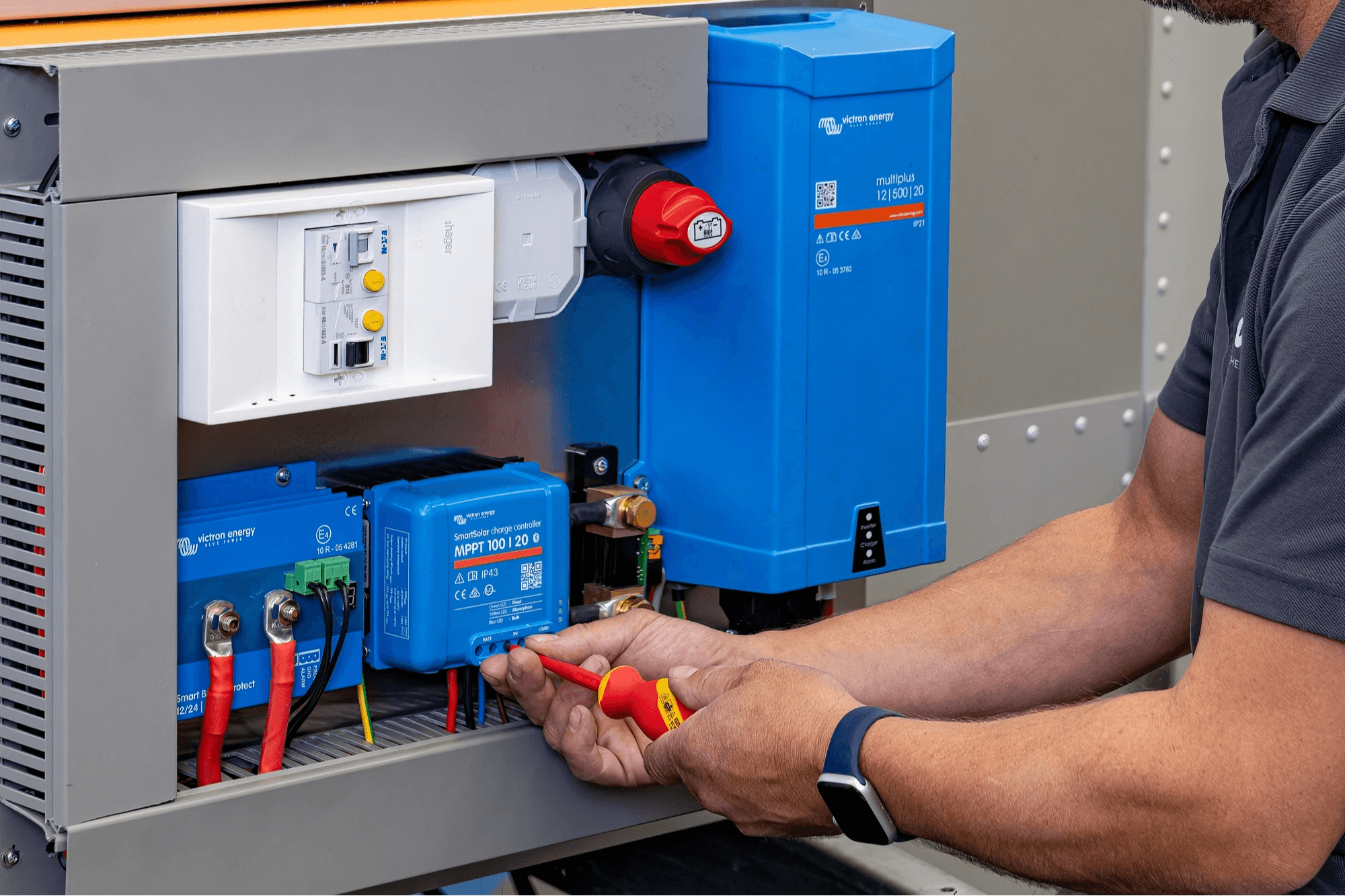
An isolator switch is the easiest way to be sure of isolating your battery from all external loads.
Integrated on/off buttons
Some lithium batteries, such as the Lithium SuperPack NG, have an integrated on/off push button. Switching the battery off with this button disables charging and discharging and also shuts down its Bluetooth module, making it the simplest way to isolate the battery for storage. Switching it off in the VictronConnect app isn’t the same: Bluetooth stays active, contributing to parasitic drain in the long-term. Because Bluetooth is off, you’ll need to switch the battery back on at the button to check it during winter.
If your electrical system is constructed in a way where removing the fuse is difficult, the certain way of isolating the battery is to disconnect the battery cables.
Disconnecting RV battery cables
When disconnecting RV battery cables, disconnect the negative cable first, then the positive cable. Reverse this order when reconnecting the battery. Once cables are disconnected, cap or cover the loose lugs with insulating tape.
Remember to check the battery’s self-discharge rate against the period you’ll leave them unattended and isolated before deciding to isolate the battery for winter.
A battery maintainer or battery tender is a smart charger that maintains your RV batteries at a storage voltage throughout the storage period. This is in contrast to a trickle charger, which simply pushes a small, constant current, regardless of battery voltage. Over a winter, this constant current overcharges the battery. For lead-acid batteries, this is a serious problem, as it causes off-gassing and loss of electrolyte. For this reason, smart battery maintainers/battery tenders should be used over trickle chargers.
Trickle chargers and battery maintainers
‘Trickle charger’ is often still used as a generic term for a small charger that supplies a maintenance charge during storage. When purchasing one of these devices, check that it has a specifically defined storage mode and programming for different battery chemistries.
The maintainer should generally be connected to the battery terminals themselves. Connect positive first, then negative, with the maintainer’s mains connection unplugged. Then, select the correct charge profile on the maintainer: match battery chemistry, and ensure storage mode is selected. Finally, plug the maintainer into the mains and check that it correctly settles into float mode, then into storage mode. Note that these are generic instructions; use of your maintainer should be based on the product manual.
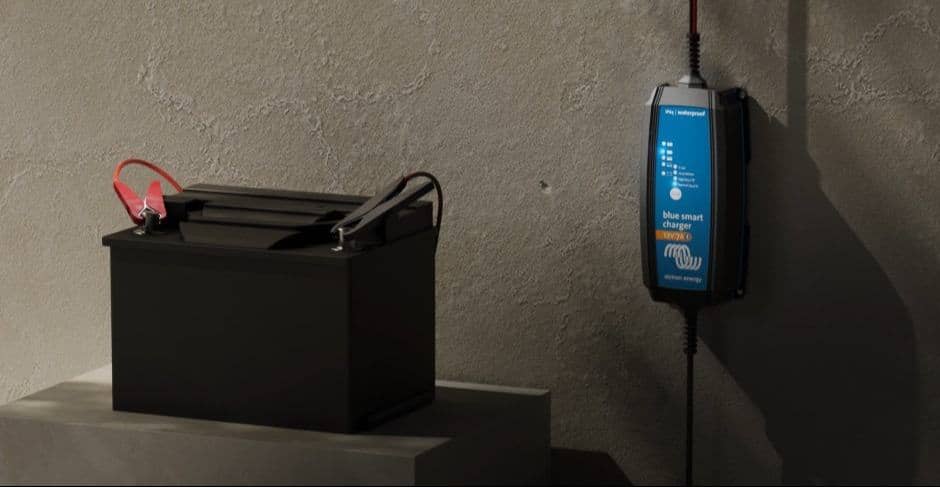
A smart battery maintainer or tender keeps an RV battery charged at a healthy level without overcharging it.
Lithium batteries need different treatment to lead-acid. Some sources advise keeping the battery charged at 50% over long storage periods. This rationale is based on the fact that lithium cells age slightly faster when held at a high state of charge for long periods. However, a near-full battery has a much bigger buffer against self-discharge, and running a battery all the way down due to self-discharge or parasitic drain is a much bigger hit to overall battery health than slightly accelerated aging at a high state of charge. Our advice is to charge the battery to the storage state of charge specified in the manual.
Once the lithium battery is charged up, the best thing to do is isolate it from the system (or switch it off at its on/off push button, if it has one), following the protocols described above. This leaves it with only its own self-discharge and the draw of its internal electronics, which should be low enough that it’ll survive winter storage without issue.
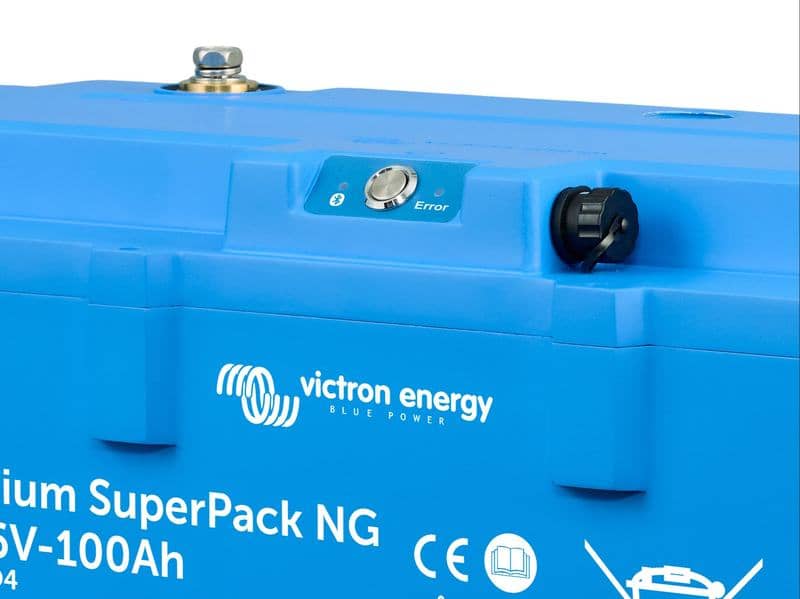
If you must keep the battery connected through winter because an essential system, like a security alarm, GPS tracker, or boat bilge pump, must remain powered, a battery maintainer is the best solution. Choose a maintainer whose lithium profile includes regular absorption periods, such as the weekly refresh on Blue Smart IP65 chargers. This gives the battery’s balancer the time it needs to complete regular cell balancing; your battery manual should provide guidance on how much balancing time is recommended per month. Note that lithium batteries should not be charged below a certain temprature (specified in the manual); the BMS’s low temperature cutoff should be set appropriately. A battery heater may be necessary to keep a lithium battery charged by a maintainer in cold temperatures. Some batteries, like the Lithium SuperPack NG, incorporate a built-in heater.
Removing your RV batteries for winter storage is usually not necessary. An isolated, low self-discharge battery, or a full lead-acid battery kept charged by a maintainer or solar power can stay in the vehicle. Battery removal is only necessary for lead-acid batteries with higher self-discharge rates (all flooded lead-acid batteries and some AGM and gel batteries) with no power or solar available.
Remove the battery as detailed above; by removing first the negative lead, then the positive. Store the battery somewhere dry and cool, away from heat sources and children. Use a battery maintainer set to the appropriate chemistry profile and in storage mode to keep the battery healthy during the storage period.
Ventilation for flooded lead-acid batteries
If charging flooded lead-acid batteries with a maintainer, ensure the space is ventilated as these batteries produce hydrogen gas when charging.
To summarise, make sure you avoid the following easy mistakes:
A battery left connected and kept charged by a maintainer or solar doesn’t need recommissioning; simply disconnect the maintainer (negative first, then positive). An isolated battery must be reconnected; reconnect the terminal leads (positive first, then negative), reinsert the fuse, and flip the isolator switch. Batteries isolated by turning them off at the integrated on/off switch need to be turned back on again. For lithium batteries, ensure the battery warms to above 5°C before reconnecting chargers.
Once everything’s reconnected, give the battery a full charge before use. This is important to restore lead-acid batteries to full charge and remove soft sulphation. For lithium, this full charge is important for rebalancing the cells.
It’s worth mentioning that good practice would be to periodically check on your RV battery over winter storage, no matter what solution you choose. For smart batteries with built-in Bluetooth, this check can be done via your smartphone as long as you’re in range of the battery. For batteries left connected and maintained by solar or a maintainer, check-ins can be done remotely via VRM if an internet-connected GX device is incorporated, or with an in-person visit. Note that batteries switched off at an integrated on/off push button won’t appear in the VictronConnect app until they’re turned back on. As always, follow your battery’s manual and consult our community forums for advice if you’re unsure.
We’ve seen that lithium batteries are often easier to store over winter than lead-acid; for more information on the benefits of lithium batteries vs. lead-acid, take a look at our detailed comparison or read about the different RV battery types in our long-form explainer.
Need advice? Our highly trained dealers are happy to help with questions, small or large.
Find a dealer near you
Check our support resources or contact your original dealer for dedicated support, repairs or warranty requests.
Support
Read more about our industry-leading 5-year standard warranty and global repair service.
Warranty


©Victron Energy 2026