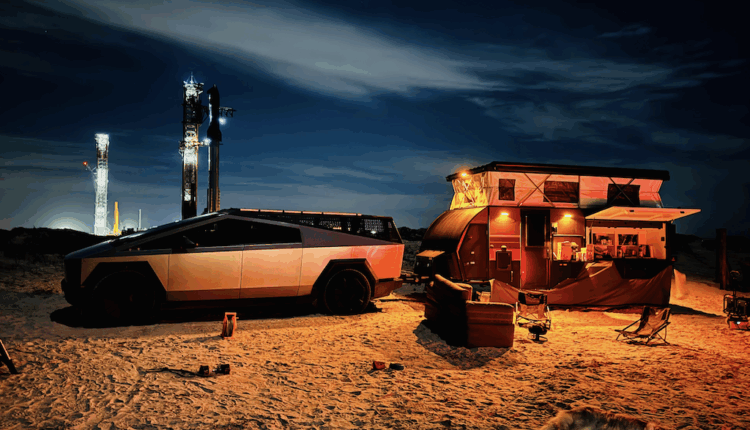
Whilst Eddie and his wife Louise go hiking, their Cybertruck refuels itself from the sun.
Proponents of living sustainably, their tow vehicle just has to be electric …and they prefer boon docking to organised sites. Those two preferences seemed to be incompatible until Eddie had an idea which would neatly combine both of them: he installed a power system in his camper which prioritises EV charging from solar power.
They tow a Fusionn Hypercamper; well-equipped for up to four people, and lightweight at just over 2 tons empty – what makes it ideal for their set up is that the Fusionn has a lifting/lowering roof:
“That lifting roof is one of the keys to low-drag electric travel,” says Eddie: “Drag coefficient is greatly reduced with our set up because, unlike a lot of towed vans, the Fusionn trailer is the same width and – with the roof down – very nearly the same height as the Cybertruck. Wind resistance is much more important than weight when it comes to maximising the range from our tow vehicle.”
Their power installation allows them to slow walk anywhere …potentially, without ever visiting a charging point. It really works for them. Here’s how they do it: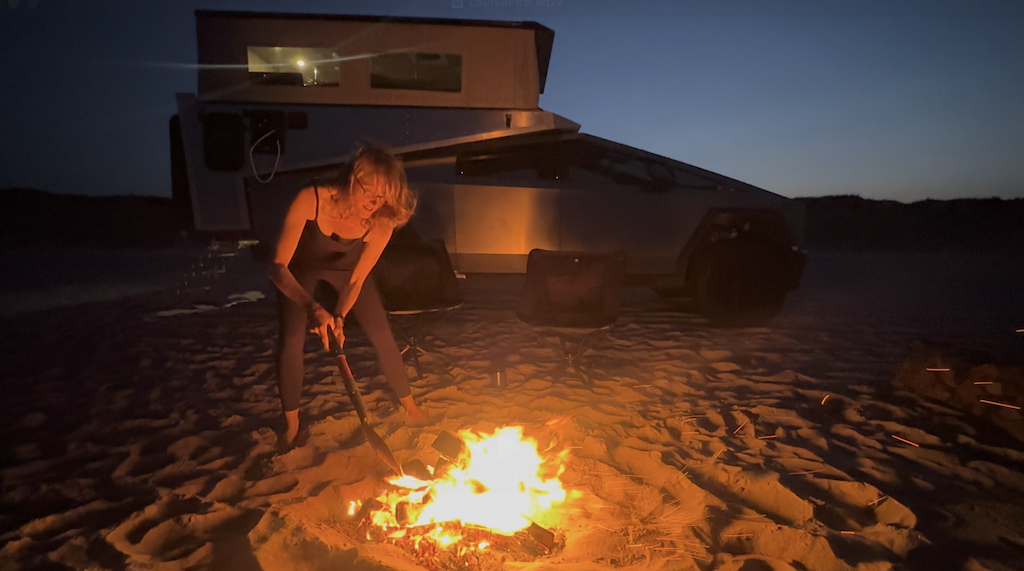
Firstly, their travel plans aren’t made around a tight schedule – they don’t need to drive hundreds of miles everyday to keep up with an ambitious travel agenda. Taking a day out to explore on foot, or chill out, their Cybertruck is busy recharging itself from the sun during their downtime, in preparation for tomorrow’s miles.
The trailer has been modified with 1400W roof-mounted solar array. They plan to upgrade the awning to add a further800W; and to max-out the power harvest they’re looking to add a solar blanket to the set up.
For every hour that they chill out, their EV battery is storing more miles. Eddie controls the charge current to a maximum of 25A. It’s capable of more than that, but he likes to dial back the amperage so that nothing gets stressed. With good conditions a couple of days off in the mountains may add 20 – 50 miles.
That way, with their go-anywhere trailer (which has impressive 33″ wheels and is fitted with all terrain tires/tyres) they plan to slow walk around the USA – whatever the weather – enjoying their off-grid lifestyle.
The power installation
Here’s their power setup:
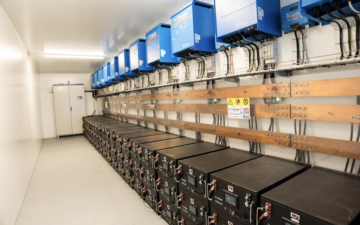
Solar Energy is harvested by two SmartSolar MPPT 150/35 solar charge controllers which store power into four Lithium NG Batteries rated at 51.2V 100Ah – offering 20kWh of stored energy. (The latest NG Next Generation batteries, by the way, feature an integrated shunt, and advanced communication which allows up to 50 batteries to be combined in the same bank. The mandatory battery management system for NG batteries is the Lynx Smart BMS NG.)
Two MultiPlus II 48/3000/35A Inverter/Chargers have been installed to act as a Level-2 (240V) EV charger.
A Cerbo GX is the data communication centre – harmonizing the entire system. It provides real time status information, and – with an internet connection – engineering access from anywhere in the world via VRM. On board the camper the same level of access is provided by a GX Touch 70 user interface.
Most of the domestic equipment on board is powered from a 12VDC circuit. The system voltage from the batteries, you may have noticed, is 48VCD; an Orion 48/12 30A DC-DC charger is used to drop down for the 12V circuits.
2 x Lynx Power-In Class-T units allow the installation to conform with ABYC circuit protection requirements.
The system was designed by Trek Systems, a U.S. based technical distributor specializing in energy solutions for mobile and remote environments.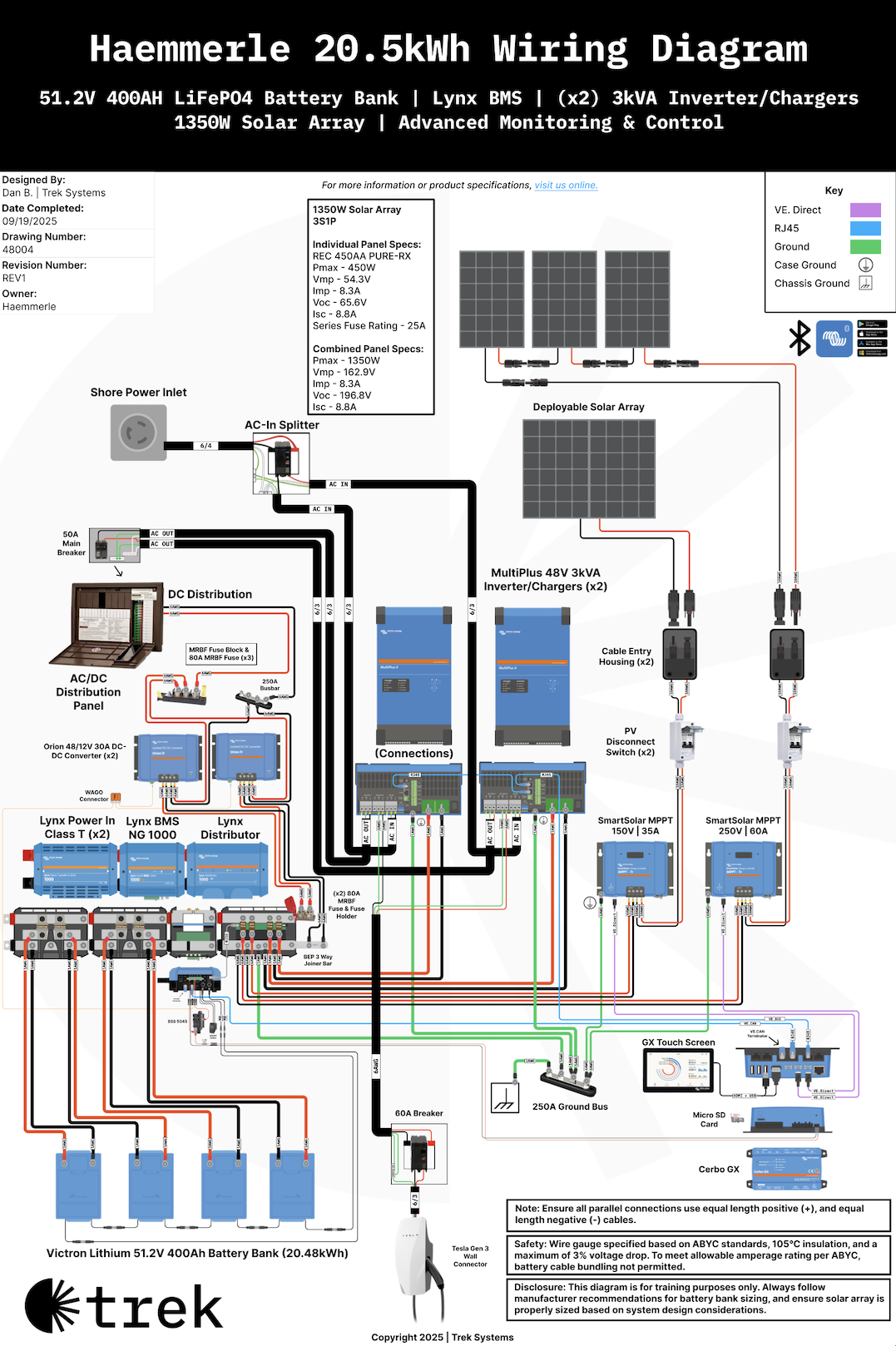
A notable exception to the DC powered domestic equipment is the induction hob fitted as part of the camper’s outdoor kitchen. The camper can also be heated electrically, but Eddie prefers to use a diesel heater. He says it’s important to have a back up fuel source – even if that means fossil fuel. They once travelled with an outside temperature of 0°F (that’s -18°C). In those conditions the ability to heat your space becomes critical and a back up diesel heater suddenly makes a lot of sense.
Fusionn Hypercamper
They won’t be short of comfort. Their Fusionn camper offers plenty of storage, a shower, outdoor kitchen cooking range with induction hob and accommodates up to four people …so you can take care of drop-by visitors.

A recent 1400 mile journey was made more conventionally, using recharging points along the way. The trip took Eddie and his wife from Boulder, Colorado; through Utah; Reno; Lake Tahoe (a long climb up to 9000 feet altitude); then San Francisco Bay and out to Las Vegas …and back.
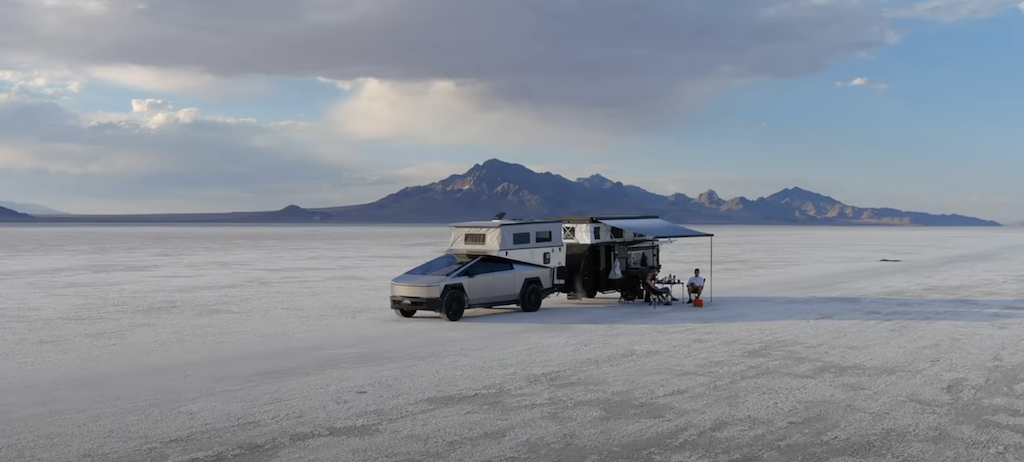
Eddie notes that when they covering a lot of miles – through remote areas and on a schedule – each time you pass an electric charging point you more or less have to stop to save range anxiety as it may be 100 miles before the next charge station.
Towing his caravan loaded up he gets a range of about 150 miles per full charge. By using EV chargers along their route they have achieved in excess of 500 miles in a day – so all travel options remain open.
CyberTruck spec sheet
Taken from the Cybertruck web page, here are a few more facts about their tow vehicle:
In All Wheel Drive – no load, no hitch – the Cybertruck is capable of 325 miles on a single charge. It can accelerate to 60mph in just over four seconds – reaching a top speed of 112 mph; and it has a towing capacity of almost five tons.
You can follow Eddie and CyberTruckOne on his YouTube channel and check out his website.
Let’s take a video tour of the Eddie and Louise’s trailer camper: